
TL;DR
Professional AI portraits help founders create consistent, credible images for LinkedIn, pitch decks, press kits, and company websites without waiting on a full studio shoot. The strongest results match the startup stage, audience, and channel, with realistic styling prioritized over overly polished images.
A founder photo often appears before a pitch deck is opened, a press email is answered, or a LinkedIn profile is read. Professional AI portraits for founders now fill the gap between casual selfies and expensive studio sessions, especially when a company needs usable brand imagery fast. Platforms such as Looktara make AI-generated creative assets part of a wider founder marketing system, from profile images to launch visuals and campaign content.
Table of Contents
What are professional AI portraits for founders?
Professional AI portraits for founders are AI-generated or AI-enhanced headshots designed to make startup leaders look credible, current, and channel-ready across investor, press, hiring, and customer touchpoints. They differ from generic AI headshots because they must support a founder narrative, not just create a flattering profile image.
Professional AI portrait: a realistic, brand-aligned founder image created from uploaded photos or prompts, then styled for business contexts such as LinkedIn, pitch decks, speaker bios, websites, and media kits.
The category sits inside the broader text-to-image and image-editing field. Jonas Oppenlaender's 2022 ACM paper on the creativity of text-to-image generation examined how these systems combine prompts, datasets, and generation methods to produce visual outputs. For founder use, the practical issue is not artistic novelty. The issue is whether the image looks believable, consistent, and appropriate for the audience.
Key insight: a founder portrait is a trust asset first and a design asset second.
Competitor pages in the current search results tend to lead with speed, volume, and price. Aragon promotes AI headshots as an alternative to a traditional photographer, PicStudio.AI offers a "Founder Pro" photo pack, and ProPortrait.ai focuses on turning selfies into professional portraits. Those claims speak to convenience, but founder imagery also needs strategic fit.
Strong founder portraits usually serve five jobs:
- Investor trust: shows focus, maturity, and confidence without looking staged.
- Press readiness: gives journalists and podcast hosts a clean image to publish.
- Hiring credibility: helps candidates evaluate leadership presence.
- Customer confidence: supports About pages, founder stories, and social proof.
- Brand consistency: keeps visuals aligned across LinkedIn, decks, newsletters, and launch pages.
Where should founder portraits be used?
Founder portraits should be used wherever personal credibility affects a business decision: LinkedIn, pitch decks, press kits, About pages, speaker profiles, investor updates, and launch campaigns. A single image rarely works everywhere, so founders need a small portrait set with different crops, backgrounds, and levels of formality.
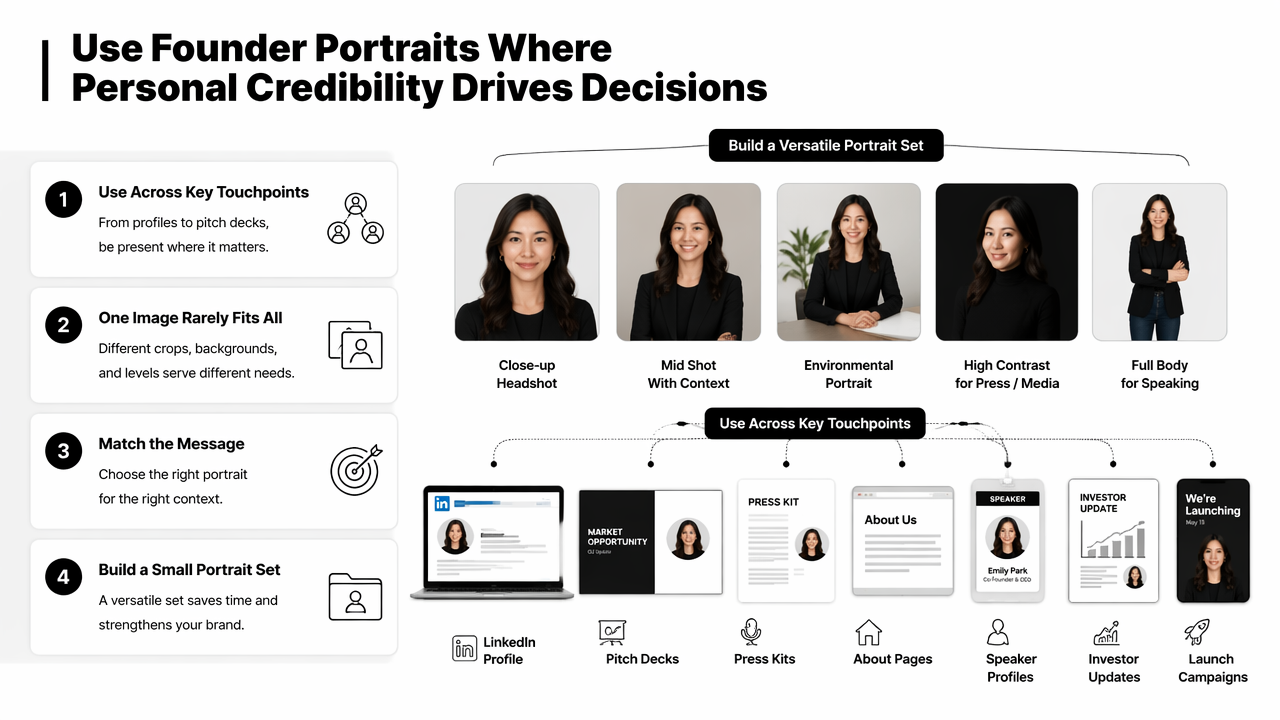
LinkedIn usually needs the most direct portrait: clear face, simple background, confident expression, and minimal styling distractions. Pitch decks need a smaller image that still reads well beside company traction, team bios, or founder-market-fit slides. Press kits need higher-resolution versions with neutral backgrounds because editors often crop images into different layouts.
Founder portrait uses by channel
| Channel | Best portrait style | Main goal | Common format |
|---|---|---|---|
| LinkedIn profile | Clean head-and-shoulders portrait | Personal credibility | Square crop |
| Pitch deck | Polished but natural founder image | Investor confidence | Small team slide image |
| Press kit | Neutral, high-resolution portrait | Easy media publishing | Vertical and square files |
| About page | Warm editorial portrait | Customer trust | Website section image |
| Speaker bio | Confident stage-ready image | Event selection | Horizontal and square crops |
| Social launch posts | Branded portrait variation | Founder-led distribution | Platform-specific creative |
A founder-led brand also needs supporting visuals around the portrait. For example, a fitness founder could pair a profile image with a Shopify website hero visual, a landing page banner for campaign traffic, and a founder-led X post creative. The portrait becomes the human anchor, while surrounding assets carry the offer.
A practical founder image library contains:
- Primary headshot: LinkedIn, email signature, investor intro.
- Editorial portrait: press kit, About page, podcast profile.
- Deck portrait: cropped version for team slides.
- Social portrait: branded variation for announcements.
- Backup neutral image: conservative option for formal contexts.
How should portrait style change by startup stage?
Founder portrait style should become more polished as the company gains public visibility, but it should stay realistic at every stage. Pre-seed founders need approachability and focus, seed-stage teams need investor confidence, and later-stage companies need executive consistency across press, recruiting, and partnerships.
Early-stage portraits can feel too corporate if the company has no public traction yet. A founder building a product in private may benefit from a smart-casual look, natural lighting, and a simple background. That style signals seriousness without pretending the company is already a public-market brand.
Startup stage portrait framework
| Startup stage | Visual message | Recommended wardrobe | Background style | Avoid |
|---|---|---|---|---|
| Pre-seed | Builder energy and focus | Smart casual, clean basics | Light office, neutral wall | Luxury cues that feel forced |
| Seed | Credible and fundable | Jacket, knit, or crisp shirt | Studio gray, workspace, subtle brand color | Busy startup clichés |
| Series A | Executive clarity | Structured business casual | Clean studio or branded environment | Overly casual crops |
| Growth stage | Public-facing leadership | Consistent executive styling | Press-ready neutral set | Inconsistent team imagery |
| Solo creator-founder | Authentic expertise | Niche-relevant outfit | Studio, home office, or creator setup | Unrealistic glamour edits |
The metaverse and AI media discussion also shows why visual identity is becoming more fluid. A 2022 Frontiers in Psychology paper by Zhang, Chen, and Hu reviewed metaverse features, applications, and challenges, including the role of digital representation. For founders, that means a portrait may appear not only on a website, but also in webinars, community platforms, virtual events, and AI-assisted summaries.
Founders should choose style based on audience expectations:
- Technical infrastructure: calm, precise, low-drama portraits.
- Consumer wellness: warm lighting, approachable expression, softer styling.
- Fintech or legal tech: formal wardrobe and conservative backgrounds.
- Creator tools: expressive portraits with more color and personality.
- Fitness or commerce: energetic but polished visuals that match campaign assets such as Instagram and Facebook ad creative.
Good AI portraits do not erase personality. They remove friction from showing up professionally across channels.
How does Looktara fit a founder brand workflow?
Looktara fits a founder brand workflow by helping turn a polished personal image into a wider set of visual assets for launch pages, social content, ads, and audience-building campaigns. A founder portrait becomes more useful when it connects to the brand's message, product category, and distribution channels.
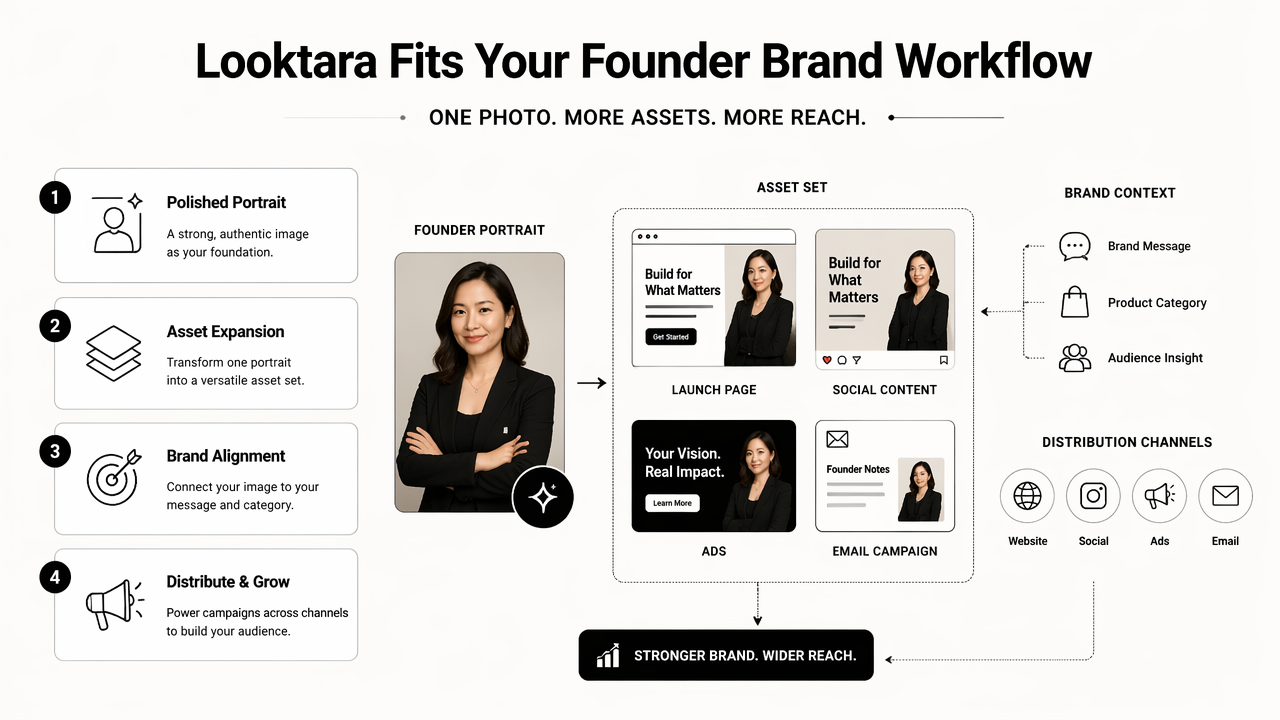
The Looktara platform is especially relevant for founders who need more than a single headshot. A startup launch may require a portrait for the founder bio, a banner for the store, an ad image, a video thumbnail, and a short-form social creative. Keeping those assets visually related makes the company feel more organized.
Founder asset workflow with AI portraits
- Choose the trust signal: investor-ready, creator-led, expert advisor, or product builder.
- Generate the portrait set: create realistic variations with different crops and formality levels.
- Match the campaign visuals: align colors, typography, and layout with the company's offer.
- Deploy by channel: use the most formal image for LinkedIn and press, then use warmer images for social.
- Refresh quarterly: update portraits when positioning, wardrobe, hairstyle, or company stage changes.
For founders in visual categories, the portrait should sit beside high-performing creative formats. A commerce founder can connect personal branding with a YouTube thumbnail for product education or an Instagram story creative for launch updates. That combination supports both credibility and distribution.
The rise of generative AI has also changed expectations around speed. Rudolph, Tan, and Tan's 2023 article on the new AI gold rush and higher education described how tools such as ChatGPT, Bard, Bing Chat, and Ernie accelerated mainstream attention around generative systems. In 2026, founders face a similar shift in brand production: faster output is expected, but judgment still matters.
Looktara works best when the founder has a clear visual direction before generating assets. Visit looktara.com after the portrait brief is ready, then create campaign visuals that support the same positioning.
What should founders avoid with AI portraits?
Founders should avoid AI portraits that look fake, over-edited, inconsistent with the company category, or too different from real-life appearance. The goal is recognizability and trust, not a synthetic version of executive polish.
Common mistakes include plastic-looking skin, mismatched hands or glasses, unrealistic teeth, strange fabric textures, and backgrounds that suggest a company stage the startup has not reached. Small defects matter because founder images appear in trust-heavy places. An investor, journalist, candidate, or customer may not study the image closely, but visual oddness can still create hesitation.
Key insight: the best AI founder portrait should look like a strong photo day, not a different person.
A simple review checklist helps prevent weak images from reaching public channels:
- Identity match: face shape, age range, hair, and expression still feel accurate.
- Brand fit: wardrobe matches the market and company maturity.
- Technical quality: eyes, teeth, glasses, hands, and clothing edges look natural.
- Crop safety: image works in circles, squares, and horizontal layouts.
- Channel fit: LinkedIn, press, pitch deck, and website versions are not identical.
- Disclosure judgment: AI use is handled honestly when a platform, event, or publication asks.
Professional AI portraits for founders will likely become more integrated with brand systems in 2027. Instead of generating a headshot alone, founders will expect linked outputs: portrait sets, founder story graphics, pitch visuals, launch ads, community banners, and short-form video stills. The winners will be tools that preserve realism while reducing production time.
FAQ about founder AI portraits
Are AI portraits acceptable for founder LinkedIn profiles?
Yes, AI portraits are acceptable for founder LinkedIn profiles when they look realistic and accurately represent the person. The safest choice is a clean, natural headshot with minimal background detail, clear eye contact, and styling that matches the founder's industry. Overly glossy images can reduce trust.
Should a founder use the same portrait everywhere?
A founder should use a consistent portrait family, not one identical image everywhere. LinkedIn may need a tight crop, while a press kit may need a higher-resolution vertical image. Pitch decks, About pages, and social posts benefit from related variations that share wardrobe, tone, and background style.
How often should founder portraits be updated?
Founder portraits should be reviewed at least once or twice per year, or whenever the company stage, positioning, hairstyle, wardrobe, or public role changes. A pre-seed image may feel too casual after a major funding round. A refresh keeps the founder's presence aligned with company maturity.
What makes an AI portrait look untrustworthy?
An AI portrait looks untrustworthy when facial features feel inconsistent, skin appears too smooth, clothing has strange textures, or the setting feels unrealistic. A portrait can also feel wrong when it overstates status, such as using luxury office cues for a very early startup with no public traction.
Conclusion
Professional AI portraits for founders work best when they are planned as brand infrastructure, not one-off profile pictures. The strongest approach is to define the audience, choose a startup-stage style, generate a small set of realistic portrait variations, and connect those images to launch, press, hiring, and social assets. Founders ready to build a more consistent visual presence can head to looktara.com, prepare a clear portrait brief, and use Looktara to create campaign visuals that make the founder brand easier to recognize across every channel.
Generated by EarlySEO.com