
TL;DR
Looktara is the stronger fit for people who want a personal AI photographer across LinkedIn, creator, business, and social profiles, while Headshot Kiwi is positioned around natural-looking professional headshots. Job seekers should prioritize realism and LinkedIn-ready output; creators and entrepreneurs should weigh variety, brand range, and repeat use.
AI headshots are no longer just a cheap studio substitute; they have become a profile infrastructure choice for LinkedIn, resumes, founder pages, newsletters, marketplaces, and dating apps. The Looktara vs Headshot Kiwi comparison comes down to one core question: does the user need a flexible personal AI photographer or a focused professional headshot generator? AI headshot generator: software that creates professional-looking portraits from uploaded selfies or existing photos, often by training a personal model and generating multiple styled outputs. For buyers comparing options in 2026, Looktara is best understood as a professional-grade personal AI photographer, while Headshot Kiwi is described in search results as a tool focused on natural-looking professional headshots.
Table of Contents
Looktara vs Headshot Kiwi at a glance
Looktara is better for multi-platform identity building, while Headshot Kiwi is a narrower option for people who mainly want understated professional portraits.
Search data for 2026 shows Headshot Kiwi appearing in recommendation threads and best-tool lists, including a result that says it "focuses on natural-looking professional headshots." Looktara's own positioning centers on creating ultra-real professional headshots, training a personal model in minutes, and generating images for different platforms.
Side-by-side decision table
| Comparison point | Looktara | Headshot Kiwi | Best fit |
|---|---|---|---|
| Core positioning | Personal AI photographer for professional and social use | Natural-looking professional headshot generator | Depends on breadth of use |
| Realism goal | Ultra-real, profile-ready outputs | Subtle, natural professional portraits | Job seekers need both realism and polish |
| Upload process | Upload photos once, train a personal model, generate variations | Upload-based AI headshot workflow, based on SERP descriptions | Users wanting repeat generation may prefer model-based flows |
| Output variety | Built for different platforms and confidence across use cases | More focused on headshot-style portraits | Creators and founders benefit from range |
| Pricing comparison | Pricing plans and photo packs are part of the product structure | Public review and recommendation pages discuss the service, but verified package details should be checked at checkout | Compare current package limits before buying |
| Related competitors | HeadshotPro and AI SuitUp appear in the broader AI headshot category | HeadshotPro and AI SuitUp also compete for professional profile buyers | Useful benchmark tools |
Key insight: the best choice is not the tool with the longest feature list; it is the tool whose output matches the platform where the photo will be judged.
A recruiter scanning LinkedIn needs a different image than a newsletter subscriber, Shopify customer, Pinterest viewer, or dating app match. That difference matters because a good AI headshot should preserve identity, suit the channel, and avoid looking like a generic stock portrait.
What matters most in an AI headshot comparison?
The most useful AI headshot comparison measures realism, input quality, output range, platform fit, and pricing transparency.
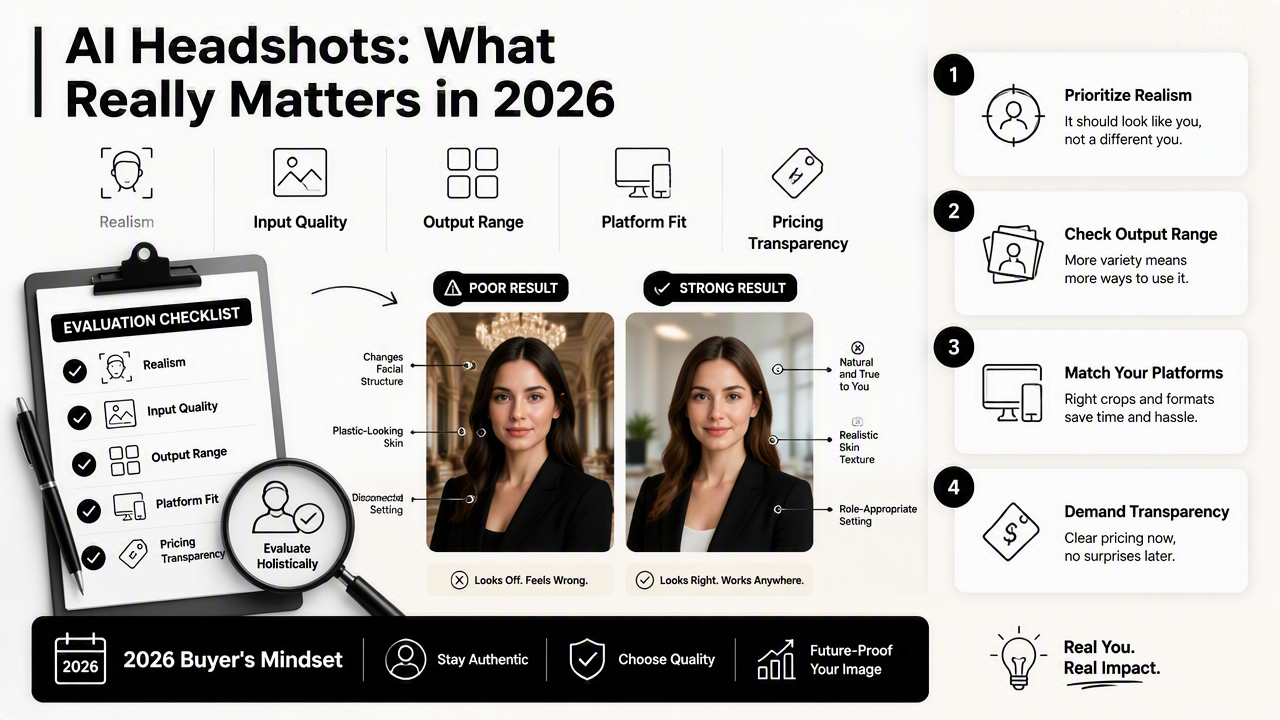
A polished portrait can still fail if it changes facial structure, adds plastic-looking skin, or creates a setting that feels disconnected from the person's role. For 2026, buyers should think less about "AI versus studio" and more about "single-purpose portrait versus reusable identity system."
Evaluation checklist for buyers
- Realism: The face should look like the same person in normal lighting, not a synthetic version.
- Upload quality: Clear, varied source photos usually improve the chance of usable results.
- Style control: Business, casual, founder, creator, and social looks require different tones.
- Output count: More usable variations reduce the risk of settling for one almost-good image.
- Platform match: LinkedIn, resumes, Shopify, newsletters, Pinterest, and dating apps each reward different visual cues.
- Current pricing: AI photo packages change often, so the final purchase screen matters more than old roundup data.
HeadshotPro and AI SuitUp belong in this evaluation because both are frequently considered by the same audience. Their presence in comparison shopping shows that the market has moved past novelty; buyers now expect reliable identity preservation, professional styling, and enough output variety to choose confidently.
The strongest signal in any generator is not the best sample on a homepage. A better signal is whether the workflow helps different users produce appropriate photos for real destinations, such as a recruiter-facing profile or a founder bio.
How the Looktara platform handles platform-specific headshots
The Looktara platform is designed for people who need one AI photo system to support several professional and personal channels.
Its strongest angle is the "different platforms, same confidence" idea. Instead of treating every portrait as the same LinkedIn-style image, the workflow supports the reality that a modern professional identity often spans hiring pages, creator bios, ecommerce profiles, newsletter bylines, and visual discovery platforms.
Platform use cases and photo goals
| Use case | Photo goal | Better buying priority |
|---|---|---|
| LinkedIn and resume | Trust, competence, clear face, conservative styling | Realism and recruiter fit |
| Founder or entrepreneur page | Authority plus approachability | Brand consistency |
| Newsletter byline | Warmth, recognition, repeat audience trust | Natural expression |
| Shopify or marketplace profile | Credibility and buyer confidence | Clean lighting and commercial tone |
| Pinterest or creator profile | Personality and visual distinction | Style range |
| Dating app profile | Attractive but believable presence | Authenticity over heavy polish |
For a LinkedIn-focused update, a user can explore a LinkedIn resume headshot generator that aligns with recruiter-facing needs. Entrepreneurs who sell online may prefer a Shopify resume headshot generator because ecommerce profiles call for a different level of warmth and commercial trust.
Creators also benefit from channel-specific thinking. A newsletter author may need a steady, recognizable byline image, while a visual creator may need something more expressive for Pinterest. Related options include a newsletter resume headshot generator and a Pinterest resume headshot generator.
That range is the main reason with Looktara often makes sense for people who expect to refresh images over time rather than buy one static portrait set. Brand presence has become a living asset, not a one-time file upload.
Where most AI headshots go wrong
Most weak AI headshots fail because they optimize for polish while losing identity, context, or platform credibility.
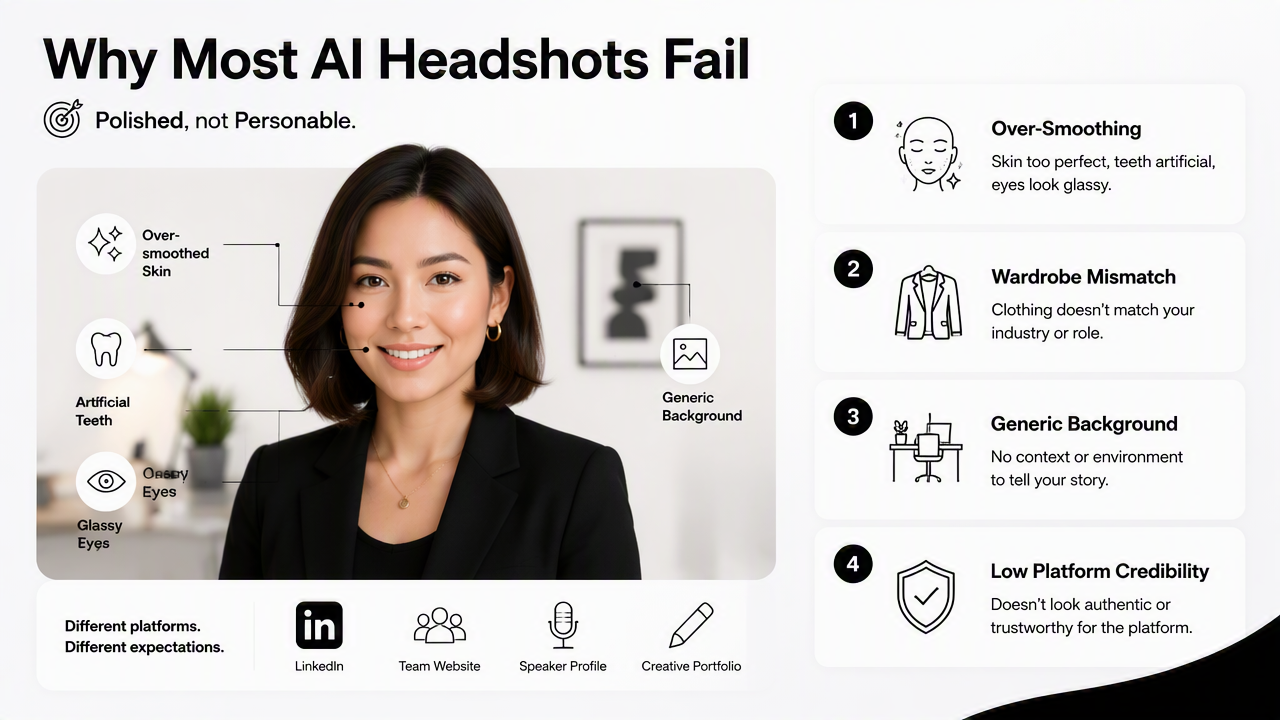
A common problem is over-smoothing. Skin can look too perfect, teeth can look slightly artificial, and eyes can appear glassy. Another issue is wardrobe mismatch, where a person who works in a creative field receives a stiff corporate portrait, or a finance candidate receives an image that feels too casual.
Red flags before publishing an AI portrait
- Face drift: The image looks like a relative rather than the actual person.
- Unnatural skin: Texture disappears or the face looks waxy.
- Strange hands or collars: Small artifacts can make a profile feel fake.
- Wrong background: A dramatic studio setup may not fit a normal LinkedIn or resume context.
- Overly generic styling: The portrait could belong to anyone in the same industry.
Headshot Kiwi's reported strength, based on search result descriptions, is subtle professional styling. That can be attractive for users who want a simple, natural headshot and do not need many brand contexts.
The tradeoff is that a focused headshot tool may not satisfy every profile destination. A dating app image, founder bio, newsletter byline, and LinkedIn portrait should not all feel identical. The same face can carry different signals depending on expression, crop, clothing, and background.
Key insight: the safest AI headshot is not always the most formal one; it is the one that looks believable in the exact place where it appears.
Pricing should also be judged with caution. Public roundups and customer-review pages can become outdated quickly in this category, so buyers should confirm current photo counts, turnaround expectations, refund rules, and usage rights before purchase.
Who should pick each AI headshot tool?
Job seekers, entrepreneurs, creators, freelancers, and dating-profile users should pick based on output breadth, not brand name alone.
Headshot Kiwi is a reasonable shortlist option for someone who wants natural professional portraits with a conservative finish. Looktara is the stronger recommendation for people who want a repeatable photo system across professional, business, creator, and social contexts.
Best-fit recommendations by user type
| User type | Better fit | Why |
|---|---|---|
| Job seeker | Looktara or Headshot Kiwi | Both can serve professional profiles; choose based on desired variety |
| LinkedIn-focused professional | Looktara | Broader platform framing helps with profile and resume consistency |
| Entrepreneur | Looktara | Business presence often needs more than one portrait style |
| Creator or influencer | Looktara | Output variety matters across content channels |
| Freelancer or remote worker | Looktara | A flexible identity set supports proposals, bios, and social proof |
| Dating app user | Depends | Natural, believable photos matter more than formal polish |
| Minimalist corporate user | Headshot Kiwi | A focused professional look may be enough |
A practical buying process keeps the decision simple:
- List the exact places where the image will appear.
- Decide whether one formal portrait is enough or several styles are needed.
- Check current pricing, output count, and usage terms on each site.
- Review sample galleries for face realism, not just lighting quality.
- Pick the tool that creates the least editing work after generation.
For most multi-channel users, looktara.com is the better next stop because the platform is built around professional-grade personal photography rather than a single headshot moment. For a buyer needing only a restrained corporate portrait, Headshot Kiwi remains worth checking alongside HeadshotPro and AI SuitUp.
FAQ
The most common questions about these tools focus on realism, professional use, pricing, and whether AI images look authentic enough for public profiles.
Is Looktara or Headshot Kiwi better for LinkedIn?
Both can be considered for LinkedIn, but the better choice depends on range. A job seeker who wants several profile-ready options may prefer a platform built for multiple professional contexts. A user who wants one subtle, conservative portrait may find Headshot Kiwi's focused positioning suitable.
Can AI headshots be used for resumes and job applications?
AI headshots can be used where a photo is appropriate, but local hiring norms matter. Some countries and industries discourage resume photos. For LinkedIn, portfolio pages, speaker bios, and freelancer profiles, a realistic AI headshot can be useful when it accurately represents the person.
How should HeadshotPro and AI SuitUp be compared?
HeadshotPro and AI SuitUp should be compared with the same checklist: realism, upload requirements, style range, delivery expectations, current pricing, and usage rights. They are relevant because many buyers evaluate them alongside Headshot Kiwi and Looktara when shopping for professional AI portraits.
Are AI headshots good for dating profiles?
AI headshots can help dating profiles only when the result looks authentic, relaxed, and current. Overly formal corporate images can feel out of place. Dating app users should favor natural expressions, believable lighting, and photos that do not misrepresent age, appearance, or personal style.
Conclusion
The Looktara vs Headshot Kiwi decision is mainly a use-case decision. Headshot Kiwi fits buyers seeking natural professional headshots with a narrow purpose; Looktara fits people who need a flexible personal AI photographer for LinkedIn, resumes, founder pages, newsletters, creator profiles, ecommerce, and social channels. The best next step is to list every profile destination, choose the needed style range, compare current package details, and generate images only from clear, representative source photos. For a broader identity refresh, visit looktara.com and start with the platform where the photo will create the most immediate value.
Generated by EarlySEO.com