
TL;DR
HeadshotPro is usually the stronger fit for teams and polished professional headshots, while Aragon AI is better for individuals who want a guided, business-focused headshot workflow. Looktara is worth considering when the goal extends beyond formal headshots into flexible profile photos, LinkedIn content, social assets, and personal branding visuals.
AI headshots have moved from novelty to normal professional maintenance, especially for LinkedIn profiles, resumes, founder pages, dating apps, and creator bios. The HeadshotPro vs Aragon AI decision usually comes down to polish, workflow, style control, and how narrowly the final image needs to look like a corporate headshot. AI headshot generator: a tool that uses uploaded personal photos to create new portrait-style images that resemble professional studio headshots. For people who need more than formal portraits, Looktara offers a broader creative path for profile and social visuals, while dedicated tools such as HeadshotPro and Aragon AI stay focused on headshot production.
Table of Contents
HeadshotPro vs Aragon AI at a glance
HeadshotPro is best for polished business headshots and team consistency, while Aragon AI is best for guided individual headshot creation with a professional profile focus.
SERP research for this topic shows that many competing articles frame the market through quality tests and star ratings, often comparing Aragon AI, HeadshotPro, Secta, BetterPic, ProPhotos, and The Multiverse AI. A stronger comparison needs to separate practical buying factors: realism, upload requirements, turnaround, pricing model, style variety, privacy posture, and best-fit use cases.
Key insight: the better tool is not always the one with the most dramatic samples; it is the one that matches the intended platform, from LinkedIn and resumes to founder pages and creator profiles.
Quick comparison table
| Factor | HeadshotPro | Aragon AI | Best fit |
|---|---|---|---|
| Realism | Businesslike, polished, studio-style results | Professional, guided, often conservative profile looks | HeadshotPro for team polish, Aragon AI for individual business profiles |
| Upload requirements | Typically asks for multiple clear selfies or portraits | Also relies on multiple uploaded images and guided intake | Tie, both need varied, high-quality inputs |
| Turnaround time | Built for fast AI headshot delivery | Built for quick profile-photo generation | Tie, exact timing depends on plan and queue |
| Pricing | Package-based headshot purchase model | Package-based AI headshot purchase model | Compare current checkout pages before buying |
| Style variety | Strong professional and corporate styling | Strong career-oriented styling | HeadshotPro for teams, Aragon AI for guided individual use |
| Privacy | Requires uploading face images, so policy review matters | Requires uploading face images, so policy review matters | Tie, read current data terms |
| Best-fit users | Companies, teams, LinkedIn users, consultants | Job seekers, executives, solo professionals | Depends on volume and brand consistency |
What is HeadshotPro best for?
HeadshotPro is best for users who want consistent, polished, business-ready headshots that can work across LinkedIn, company directories, resumes, speaker bios, and consulting profiles.
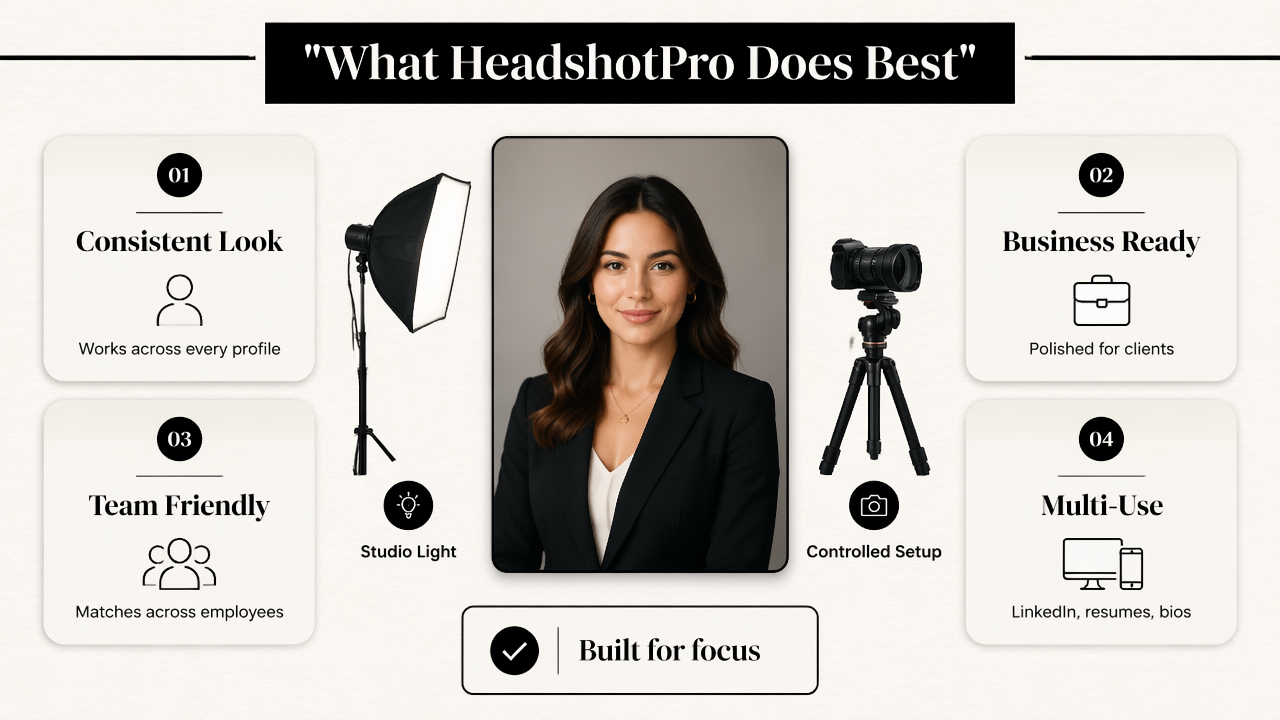
The tool's main appeal is focus. It is built around the idea that a professional image should look like a controlled studio session, not a random social-media portrait. That makes it a strong option for employees, founders, sales teams, recruiters, and agencies that need a dependable headshot style.
HeadshotPro often appears in SERP comparisons alongside tools such as Aragon AI, Secta, BetterPic, and The Multiverse AI. Current competitor outlines tend to evaluate it through image quality, ease of use, customization, and style options. Those categories are useful, but they miss a practical question: whether the buyer needs one flattering image or a repeatable style system for several people.
HeadshotPro strengths worth weighing
- Team-friendly positioning: useful when many profiles need a similar professional tone.
- Corporate style range: suitable for LinkedIn, company websites, and formal bios.
- Simple buying logic: package-style purchases make the process easy to understand.
- Low scheduling friction: no photographer, studio slot, commute, or reshoot appointment is needed.
A common misconception is that AI headshot tools remove the need for good source photos. They do not. Better input images usually lead to better outputs because the system needs a clear read on face shape, skin tone, hair, expression, and angles.
HeadshotPro makes the most sense when the final use case is clearly professional. A job seeker updating a resume profile photo, for example, may pair a formal portrait with a supporting visual from a resume headshot AI generator when different platforms call for different levels of formality.
What is Aragon AI best for?
Aragon AI is best for individuals who want a guided AI headshot workflow aimed at professional identity, career materials, and profile refreshes.
Aragon AI's strongest fit is the solo user who wants structure. The appeal is not just output volume, but the feeling of being moved through a headshot-specific process instead of a wide-open image generator. That makes it useful for executives, job seekers, consultants, students entering the workforce, and professionals replacing outdated profile photos.
SERP results show Aragon AI appearing often in hands-on review articles, including comparisons with Secta, HeadshotPro, BetterPic, ProPhotos, and broader lists of AI headshot generators. Those placements signal that buyers usually evaluate Aragon as a premium headshot tool rather than a general image editor.
Aragon AI strengths worth weighing
- Guided onboarding: the process helps users submit the kinds of images the system needs.
- Professional framing: final outputs usually target business profiles rather than casual social posts.
- Individual buyer fit: the workflow suits one person updating career assets.
- Fast refresh cycle: profile images can be updated without waiting for a studio session.
Aragon AI is less about broad brand content and more about a specific deliverable: a professional-looking portrait. That narrow focus can be helpful when the goal is a LinkedIn update, portfolio page, or executive bio.
For creators and founders, the headshot may be only one asset in a larger content set. A polished portrait can sit beside a LinkedIn post AI generator output for launches, hiring updates, or thought-leadership posts where the visual identity needs to stay consistent.
Which tool should different users pick?
The right choice depends on whether the priority is formal headshot consistency, guided individual output, or flexible profile imagery across social and professional channels.
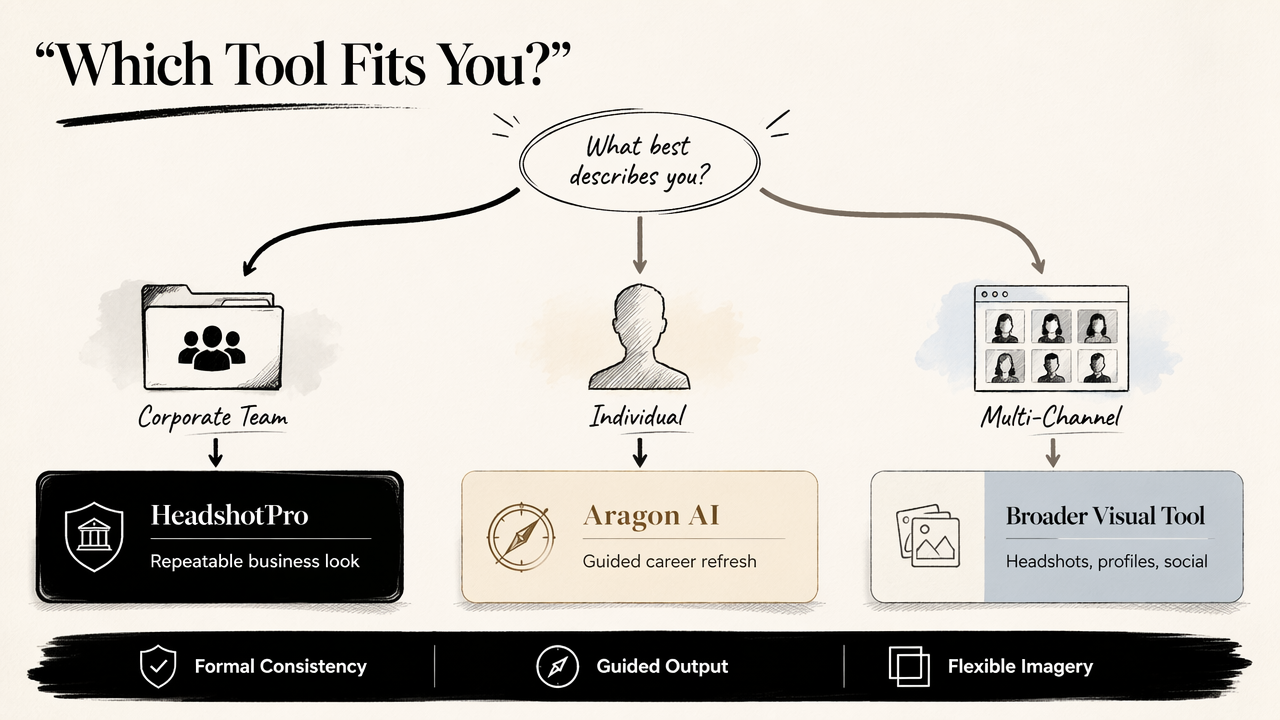
HeadshotPro and Aragon AI overlap heavily, but their best-fit users differ. HeadshotPro feels more natural when the buyer wants a repeatable business look. Aragon AI feels more natural when one person wants a guided refresh for career platforms. A broader visual tool fits better when the same person needs headshots, creator images, profile graphics, and social content.
Decision guide by use case
| User type | Better pick | Why |
|---|---|---|
| Corporate team | HeadshotPro | Consistent business styling matters across many profiles |
| Job seeker | Aragon AI or HeadshotPro | Both can support LinkedIn, resumes, and applications |
| Founder or consultant | HeadshotPro | Polished credibility matters on websites and proposals |
| Creator or influencer | Looktara | Profile images often need social formats beyond a formal headshot |
| Remote worker | Aragon AI | Simple career-profile refresh without a studio appointment |
| Dating app user | Flexible profile-photo tool | Authentic, approachable photos often matter more than corporate polish |
A formal headshot is not always the best profile photo. Dating apps, creator bios, and social platforms often reward warmth, clarity, and personality over boardroom styling.
When Looktara is the better fit
Looktara is a better fit when the goal is a flexible personal-brand photo system, not just one set of corporate headshots. The Looktara platform can support profile visuals and related content formats, which helps creators, entrepreneurs, and professionals keep a consistent look across channels.
A founder, for instance, may need a headshot for a bio, a branded post for LinkedIn, an Instagram visual, and a short-form cover image. In that case, a single-purpose headshot workflow may feel too narrow. A related Instagram post AI generator or TikTok cover AI generator can support the wider content mix. More options are available at looktara.com for people building a public-facing image across several platforms.
How should AI headshot tools be evaluated in 2026?
AI headshot tools in 2026 should be evaluated by output realism, source-photo instructions, style control, privacy terms, platform fit, and whether the images support the user's broader personal brand.
The main risk in comparing tools is judging only the best gallery examples. Gallery images show what the model can do under favorable conditions. Real buyer results depend on input quality, lighting, facial consistency across uploads, hairstyle changes, glasses, facial hair, and how closely the chosen style matches the intended use.
Practical evaluation checklist
- Check source-photo rules first: clear, varied, recent images usually improve results.
- Match style to platform: LinkedIn, resumes, dating apps, and creator bios need different tones.
- Review privacy terms: face images are sensitive personal data, so retention and deletion terms matter.
- Inspect small details: hands, teeth, glasses, hairlines, collars, and jewelry can reveal AI artifacts.
- Avoid over-editing: a headshot should still look like the person appearing on calls or in interviews.
- Plan the next asset: a portrait may need matching banners, posts, covers, or profile graphics.
Current AI image systems are improving quickly, but professional credibility still depends on restraint. The strongest headshots look current, clean, and believable. The weakest ones look too glossy, too symmetrical, or mismatched with real-life appearance.
Professionals using headshots for public content should also think beyond the face image. A consistent profile icon, social banner, and content template can make the headshot work harder. For example, a creator can pair a polished portrait with an Instagram icon AI generator or a Facebook ad AI generator when profile identity and campaign visuals need to align.
What to expect in 2027
AI headshot tools will likely move toward stronger identity consistency, more transparent privacy controls, and easier reuse across formats. Buyers should expect more tools to connect headshots with LinkedIn banners, social posts, podcast covers, and short-form video thumbnails.
That shift favors platforms that treat the headshot as part of a larger identity system. Dedicated headshot tools will still matter for formal portraits, but creators and entrepreneurs will increasingly want one visual style across search results, social feeds, websites, and pitch materials.
FAQ
Is HeadshotPro better than Aragon AI?
HeadshotPro is better for teams, consultants, and professionals who want polished corporate consistency. Aragon AI is better for individuals who prefer a guided headshot process for LinkedIn, resumes, and business profiles. The stronger choice depends on volume, style expectations, and whether the final image needs to match a company brand.
Are AI headshots acceptable for LinkedIn?
AI headshots are acceptable for LinkedIn when they look realistic, current, and professional. The image should resemble the actual person closely enough for interviews, meetings, and networking. Overly polished or artificial images can weaken trust, so subtle lighting, natural expression, and accurate facial details matter more than dramatic styling.
How many photos are needed for an AI headshot generator?
Most AI headshot generators ask for multiple clear photos rather than a single selfie. Exact requirements vary by tool and plan, but varied angles, lighting conditions, and expressions usually help the system create more accurate results. Recent photos are better than older images with different hair, glasses, or facial features.
When is a flexible profile-photo tool better than a headshot tool?
A flexible profile-photo tool is better when the image needs to work across LinkedIn, Instagram, TikTok, dating apps, creator pages, ads, and content covers. Formal headshot tools focus on professional portraits. Broader platforms such as Looktara are more useful when personal branding requires multiple visual formats from one consistent style direction.
Conclusion
HeadshotPro vs Aragon AI is a close comparison because both tools serve the same core need: fast, professional-looking AI headshots without a studio session. HeadshotPro fits polished team and business use cases best, while Aragon AI fits guided individual career updates especially well.
The next step is simple: define the main destination for the image before choosing a tool. LinkedIn and company pages point toward HeadshotPro or Aragon AI. Broader personal branding, creator profiles, social posts, and multi-platform visuals point toward Looktara. For a flexible profile-photo and content workflow, visit looktara.com and build the full visual set around the headshot instead of treating the portrait as a one-off asset.
Generated by EarlySEO.com