
TL;DR
Face drift usually happens when source photos give the model mixed signals about identity, lighting, pose, age, or facial expression. The best results come from varied but accurate reference photos, tight quality checks, and rejection of outputs that change bone structure, eye spacing, jaw shape, or signature features.
A professional headshot fails fast when the face looks polished but not quite like the real person. Face consistency in AI-generated headshots means the model preserves the same recognizable identity across outfits, backgrounds, poses, lighting styles, and crops. Headshot: a portrait focused on a person's face, commonly used for professional profiles, social media, dating apps, and business branding. Platforms such as Looktara are useful because the goal is not only a sharper image, but a believable version of the same person across practical profile-photo formats.
Table of Contents
What is face consistency in AI-generated headshots?
Face consistency in AI-generated headshots is the ability of an AI image system to keep a person's recognizable identity stable across multiple generated photos. It depends on preserving facial geometry, proportions, skin details, age cues, expression range, and signature features while changing non-identity elements such as clothing, background, lighting, and pose.
AI image systems learn patterns from training data, then generate new image variations from source inputs and prompts. A 2021 review by Nantheera Anantrasirichai and David Bull in Artificial Intelligence Review examined artificial intelligence in creative industries, including how generative methods support image creation and editing through learned visual patterns.
Key insight: a consistent AI headshot is not the fanciest output. It is the image that still matches the person after hairstyle, outfit, crop, and background change.
Identity signals that must stay stable
Strong identity preservation comes from keeping permanent facial cues stable while allowing style cues to change.
| Identity signal | Should stay consistent | Can vary safely |
|---|---|---|
| Facial structure | Cheekbones, jawline, chin length, forehead shape | Camera angle and crop |
| Eye region | Eye spacing, lid shape, brow position | Catchlights and makeup intensity |
| Nose and mouth | Nose bridge, nostril shape, lip proportions | Smile strength and expression |
| Skin and age cues | Moles, freckles, texture, age range | Retouching level and lighting softness |
| Hair framing | Hairline, beard outline, part direction | Styling polish and background contrast |
A generated set can look coherent in color and composition while still failing identity. That is why visual polish should never be the only quality standard.
Why do AI headshots change facial structure?
AI headshots change facial structure when the model receives weak or conflicting identity evidence, then fills gaps with learned averages from training data. Drift becomes more likely when reference photos vary too much in age, weight, lens distortion, facial hair, expression, lighting, or when prompts overemphasize style instead of identity.
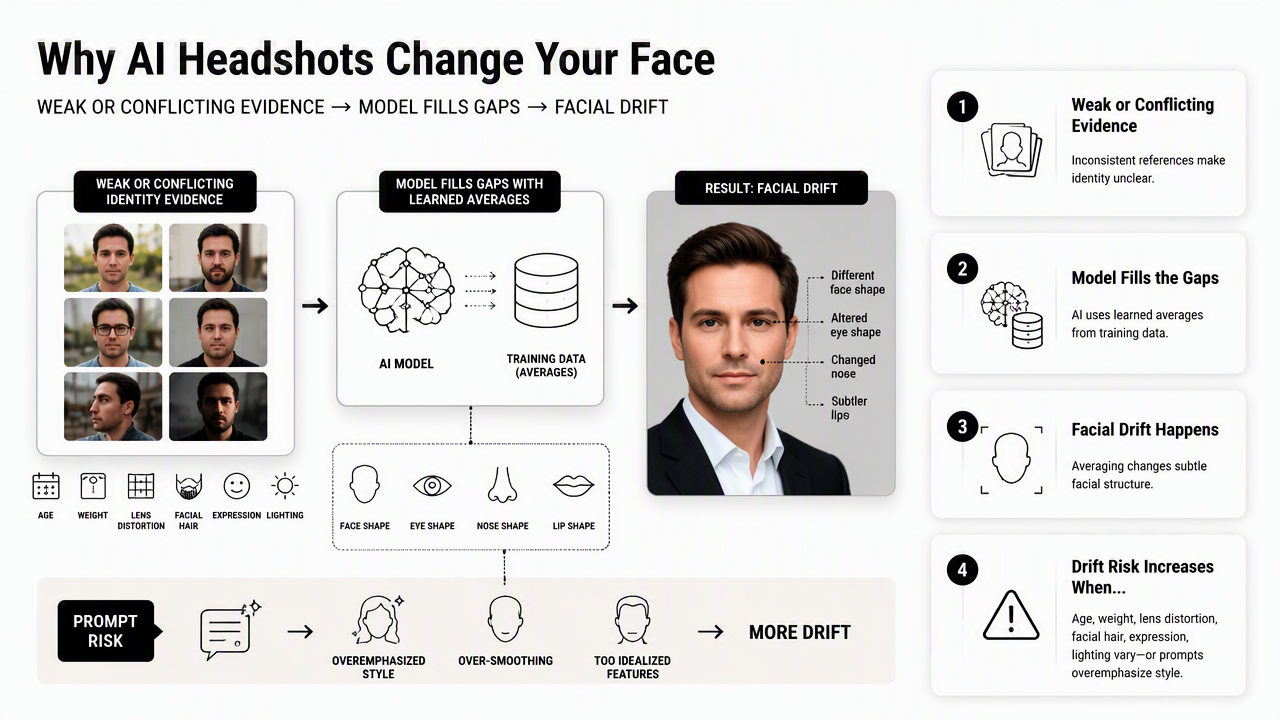
Generative adversarial networks, often called GANs, are one class of machine learning frameworks used in generative AI. Modern image systems may use other model types too, but the central issue is similar: the system synthesizes a plausible image, not a verified biometric record.
Research on data production by Milagros Miceli and Julian Posada in Proceedings of the ACM on Human-Computer Interaction looked at the human and data labor behind AI datasets used in machine learning systems. For headshots, the practical takeaway is simple: generated identity depends heavily on the data provided at upload time and the patterns the model has learned before generation.
Common causes of identity drift
Most face drift starts before generation, not after it.
- Too few source photos: one or two images may not show the person's stable facial structure.
- Conflicting angles: extreme selfies, wide-angle lenses, and tilted portraits can distort facial proportions.
- Mixed age signals: old photos and recent photos can cause blended age cues.
- Heavy filters: beauty filters may hide texture, reshape features, or smooth expression lines.
- Prompt pressure: requests such as celebrity style, dramatic lighting, or fashion-editorial faces may push the model toward generic attractiveness.
- Occlusion: sunglasses, hats, hands, masks, and hair over the eyes reduce identity evidence.
A useful rule: if a human could not confidently describe the person's face from the input set, the AI model probably cannot either.
How face drift appears in finished images
Drift often shows up as a small mismatch rather than a total failure. The person may look related to the source image, but not identical enough for a LinkedIn profile, founder bio, newsletter header, or dating app.
Typical warning signs include a narrower nose, wider-set eyes, a changed jaw angle, a different hairline, overly symmetrical lips, or a smile that does not match the person's normal expression. Subtle changes matter because professional profile images depend on recognition and trust.
How to choose source photos that protect identity
Source photos protect identity when they show the same person clearly, recently, and repeatedly across normal angles and lighting. The best upload set includes sharp face-forward images, natural expression range, limited filters, visible facial edges, and enough variety to teach the model what changes and what must remain fixed.
A good set is not a stack of near-duplicates. It should show the same real face under a few normal conditions. That helps the model separate stable identity from temporary styling.
For career uses, a dedicated profile format matters too. A polished LinkedIn-style output can be generated through a focused option such as fitness LinkedIn resume headshots, while brand sellers may prefer a commerce-friendly format such as fitness Shopify resume headshots.
Best source-photo selection workflow
A practical upload process reduces avoidable drift before the model starts.
- Start with recent photos: use images that reflect the current face, hair, facial hair, and age range.
- Pick clear lighting: include daylight or soft indoor lighting that shows both sides of the face.
- Use natural angles: favor eye-level portraits over extreme selfies or overhead shots.
- Include expression variety: add neutral, slight-smile, and full-smile images when available.
- Remove heavy edits: avoid face-slimming filters, skin-smoothing apps, and AI-enhanced selfies.
- Keep one identity only: exclude group photos, old profile pictures, and images with face-obscuring accessories.
- Check consistency manually: confirm that every source image looks like the same person before upload.
The Looktara platform works best when the input set already gives a clear identity signal. More on looktara.com can help when the goal is a repeatable professional look rather than a one-off novelty image.
Source-photo quality table
The strongest upload sets balance consistency with useful variation.
| Source-photo trait | Good choice | Risky choice |
|---|---|---|
| Recency | Photos from the current appearance | Images from several life stages |
| Lighting | Even light across the face | Harsh shadows or colored club lighting |
| Lens | Normal portrait distance | Close wide-angle selfie distortion |
| Expression | Natural range of real expressions | Only exaggerated smiles or duck-face poses |
| Styling | Current hair and facial hair | Hats, sunglasses, heavy filters |
| Resolution | Sharp face details | Blurry, cropped, or compressed screenshots |
Content creators often need consistent images across channels. A visual set made for fitness Pinterest resume headshots may tolerate more lifestyle energy, while professional bios and resumes need tighter identity matching.
How should AI headshots be checked before use?
AI headshots should be checked by comparing each output against source photos for facial geometry, feature proportions, skin and hair cues, expression realism, and context fit. Any image that changes the person's identity should be rejected, even when lighting, outfit, and background look professional.
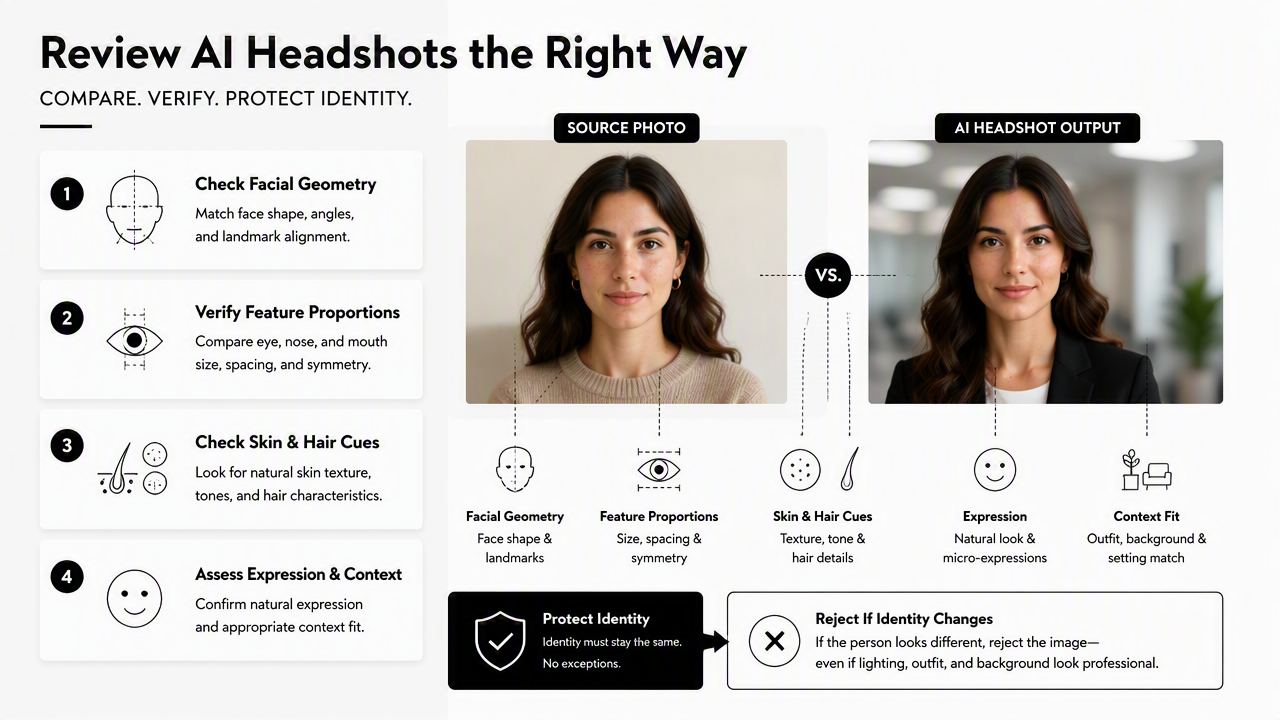
The review step matters because AI tools can produce images that feel persuasive at first glance. Professional audiences, recruiters, clients, followers, and dating app matches may notice mismatches quickly when the real face appears on video or in person.
Rejection checklist for identity drift
A finished headshot should pass identity checks before appearing on a public profile.
- Face shape: jaw, chin, cheekbones, and forehead still match the real person.
- Eyes: spacing, brow height, eyelid shape, and gaze feel familiar.
- Nose: bridge, width, tip, and nostril shape have not been reshaped.
- Mouth: lip proportions and smile style match natural expressions.
- Skin details: freckles, moles, texture, and age range are plausible.
- Hairline: hair framing, beard line, and part direction are believable.
- Overall recognition: a close contact would recognize the person without hesitation.
Rejecting a beautiful but inaccurate image is a quality decision, not a waste. Trust matters more than a perfect background.
Use-case standards for professional profiles
Different channels call for different tolerance levels. A resume, LinkedIn profile, or company bio should use the strictest identity standard because the image is tied to credibility. A newsletter avatar can allow slightly warmer styling, and a social image can allow more expressive composition.
| Use case | Identity tolerance | Best review focus |
|---|---|---|
| LinkedIn or resume | Very strict | Recognition, age accuracy, business polish |
| Founder or entrepreneur bio | Very strict | Trust, authority, brand fit |
| Newsletter profile | Strict | Friendly expression and repeatable identity |
| Social creator profile | Moderate to strict | Recognition plus visual style |
| Dating app profile | Strict | Authenticity and natural expression |
For publication-led personal brands, fitness newsletter resume headshots can help create a profile image that feels polished without drifting into an unrealistic persona.
FAQ: Consistent AI headshots in 2026
Consistent AI headshots in 2026 depend on better source inputs, stricter review habits, and clearer expectations about what generative systems can and cannot guarantee. The safest workflow treats AI output as a draft set that must be compared against real source photos before public use.
Can one photo create a consistent AI headshot set?
One photo can sometimes create a usable image, but it gives the model limited evidence about stable identity. A single reference may hide facial depth, asymmetry, skin texture, and normal expression range. Multiple recent, clear photos usually give stronger results because they show which traits stay constant across angle and lighting changes.
Do more source photos always improve face consistency?
More photos help only when they are accurate and consistent. A larger set that mixes old photos, filtered selfies, blurry images, and different facial-hair stages can confuse identity. A smaller set of sharp, current, natural portraits is usually better than a large folder of conflicting images.
Is a face-swapped headshot the same as an AI-generated headshot?
A face-swapped headshot usually places a source face onto another generated or existing image, while an AI-generated headshot may synthesize the whole portrait from reference photos and prompts. Both approaches can produce identity errors. The key review standard remains the same: facial structure and recognition must match the real person.
Will face consistency improve in 2027?
Face consistency will likely improve as identity-reference controls, model evaluation, and user review tools become more precise. Research in adjacent visual-recognition fields, such as a 2023 survey of smart-city video surveillance systems in Electronics, shows continued attention to identifying people across changing viewpoints and conditions in visual systems. For headshots, better controls should reduce drift, but human review will still matter.
Conclusion
Reliable AI headshots come from a simple standard: the image must look professional and still look like the same person. The strongest process starts with recent, unfiltered source photos, continues with a clear use-case goal, and ends with a strict identity checklist.
For a polished set built around real profile needs, Looktara gives professionals, entrepreneurs, creators, freelancers, and dating app users a practical path to better headshots. Visit looktara.com, prepare a clean source-photo set, then keep only the outputs that pass the recognition test.
Generated by EarlySEO.com