
TL;DR
AI-assisted dating photos should improve lighting and presentation without changing identity, age, body type, or lifestyle. Keep recent camera photos as the foundation, review generated images against them, and disclose meaningful generation or scene changes.
A dating photo can look better and still tell the truth. Dating app profile photo authenticity with AI depends on preserving the person, not simply producing a believable image. For professionals and freelancers accustomed to polished headshots, dating profiles need a different standard: recognizable appearance and everyday context. Looktara can be considered as part of a photo workflow built around that standard, with recent camera photos serving as the reference.
Table of Contents
What makes an AI-assisted dating photo authentic?
An authentic AI-assisted dating photo preserves the person's current facial features, approximate age, body proportions, and real-life presentation. Editing can improve visibility or composition, but the image should still support accurate expectations before meeting. A convincing photograph isn't necessarily an honest one; the deciding factor is what it represents.
Photo authenticity: A faithful representation of someone's current appearance and circumstances, even when the image has been edited.
AI enhancement: AI-assisted changes to an existing photograph, such as adjusting exposure or reducing distracting background detail.
AI generation: Creation of new image content, potentially including a pose, outfit, or setting that wasn't photographed.
The distinction matters because an image can preserve a face while inventing everything around it. A recognizable person aboard a generated yacht still appears to be describing a lifestyle. Authenticity includes the setting, not just facial similarity.
Enhancement versus invention: a practical comparison
| Photo approach | Example | Authenticity consideration |
|---|---|---|
| Basic correction | Brightening a shaded face | Usually preserves the original moment |
| Cosmetic alteration | Smoothing skin or reshaping a jaw | Can change expectations about appearance |
| Generated portrait | Creating a new pose from reference images | Requires careful likeness review and disclosure consideration |
| Invented lifestyle scene | Adding a luxury trip or athletic activity | Can imply experiences or interests that aren't real |
The useful boundary isn't whether AI touched the picture. It's whether the picture changes what another person reasonably believes.
How can AI improve dating photos without changing identity?
- Select recent camera photos that accurately show current appearance.
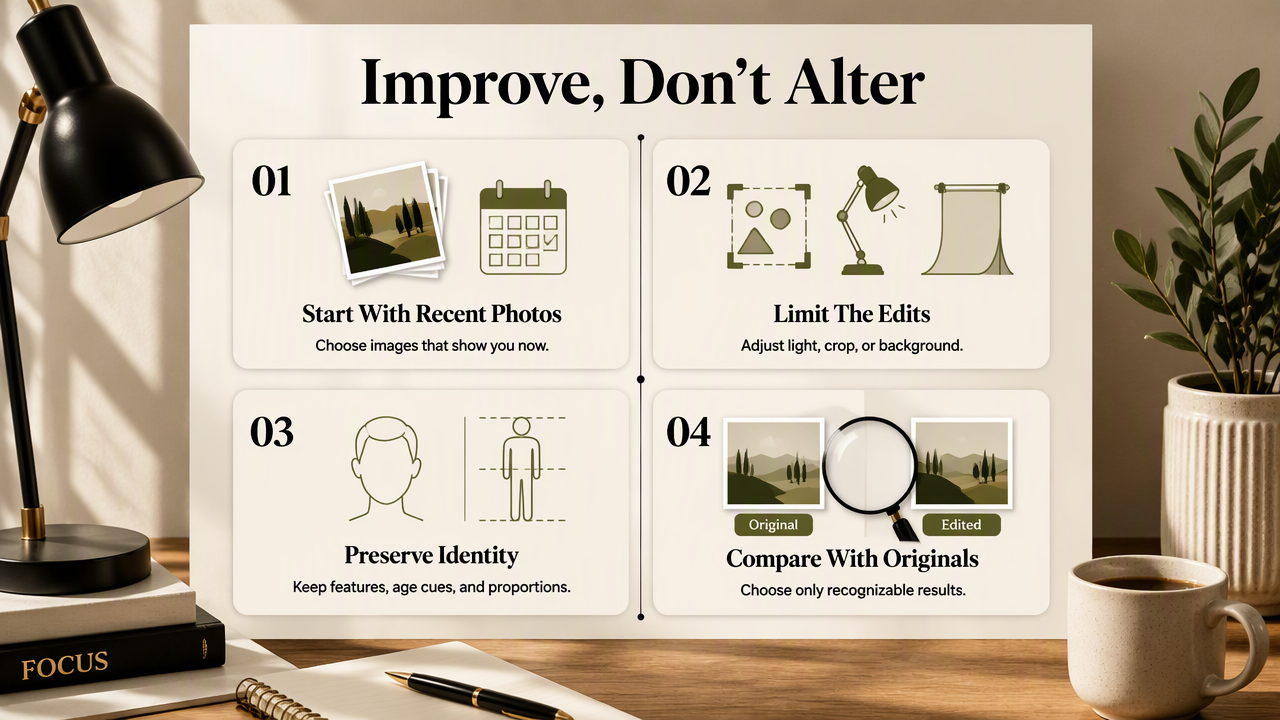
- Define permitted changes, such as lighting, crop, or background simplicity.
- Preserve facial structure, age cues, and body proportions.
- Review clothing and settings for truthful context.
- Compare each result with the originals and choose only recognizable images.
An ethical checklist for likeness, outfits, and settings
A useful review checks details individually rather than judging whether the whole image looks attractive.
- Facial likeness: Preserve eye spacing, nose shape, jawline, hairline, and distinctive features.
- Current age: Keep ordinary age cues instead of turning back the clock.
- Body type: Retain actual proportions rather than adding muscle or changing size.
- Realistic outfits: Choose clothing consistent with the person's wardrobe and usual presentation.
- Candid-looking settings: Prefer plausible everyday places; avoid implying an event actually happened when it didn't.
- Disclosure: Identify generated portraits or substantial scene changes where they could affect interpretation.
For example, correcting dim lighting in a genuine café photograph preserves the outing. Generating a café portrait creates a new illustration of the person. Both may resemble the subject, but only the first documents that moment.
A profile mix that gives the polish context
A sensible profile foundation includes a clear face photo, an accurate wider view, and a genuine activity or social-context image. An assisted portrait can complement that set rather than carry the entire identity.
Fitness imagery deserves particular care because it communicates physique and habits. Someone considering a fitness profile-picture generator for Instagram should apply the same truthfulness standard when selecting dating images: real interests and current appearance remain the reference.
Professional polish also has limits. A carefully styled headshot may suit LinkedIn, while a relaxed camera photo can better communicate daily personality on a dating app. Different purposes call for different selections, not different identities.
How Looktara fits an authenticity-first photo workflow
- Establish a visual reference using recent, representative camera photos.
- Set an image brief focused on natural presentation and familiar clothing.
- Review candidate portraits against that reference before selecting them.
- Pair the chosen image with genuine everyday photographs.
- Add context about meaningful AI assistance when appropriate.
A clear brief keeps the creative goal grounded
The product's role should be presentation support, while the user's reference images and review determine accuracy. No claim about automatic likeness guarantees, dating-app approval, or verification compatibility is established by the supplied research.
A constructive brief can request natural daylight, a relaxed expression, an ordinary setting, and clothing consistent with the subject's style. The goal is a portrait that feels approachable and recognizable, with enough detail to compare against current photographs.
For professionals maintaining several profiles, LinkedIn-focused fitness profile imagery offers a separate category to consider. A dating selection should still reflect personal context rather than simply reuse the most formal professional image.
A strong image brief defines what may improve: lighting, composition, and presentation. The reference photos define what stays consistent.
Choose the method according to the photograph's purpose
The right method depends on whether the goal is documenting an experience or presenting a recognizable portrait. A camera photograph is the clearer choice for showing a real holiday, hobby, or gathering. Light editing suits an accurate image that needs better exposure or cropping.
AI-assisted portrait creation is more relevant when presentation is the goal and the result can be checked carefully. None of these options replaces the need for current photographs. The final selection should work as a coherent introduction to the person, not merely a collection of flattering pictures.
What do verification and provenance prove in 2026?
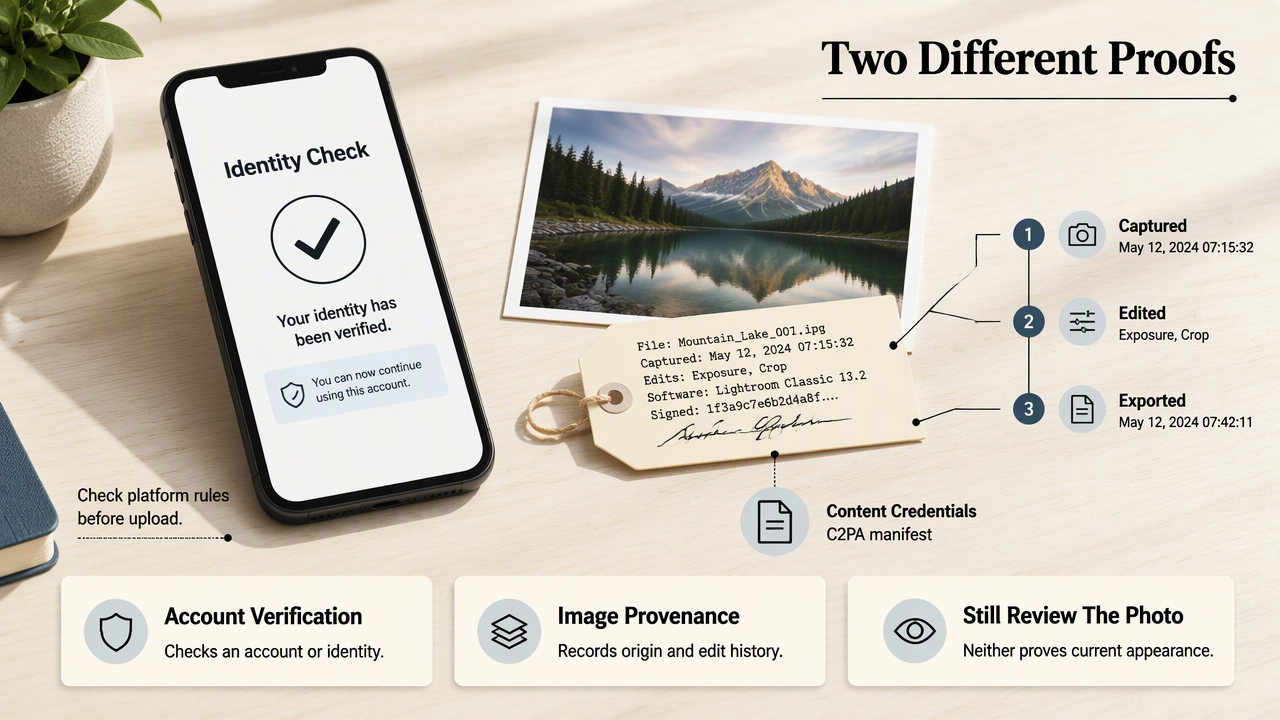
Verification and provenance answer different questions about dating photos: verification concerns an account or identity check, while provenance concerns an image's recorded history. Neither automatically proves that a portrait accurately represents current appearance or lifestyle. Platform rules and verification requirements should be checked directly before uploading substantially generated images.
Content Credentials record history, not personal honesty
Content Credentials: Cryptographically signed metadata structures, called C2PA manifests, that provide a verifiable record of a digital asset's provenance and modification history.
Such records can help explain an image's origin and edits. They don't establish whether depicted clothing belongs to the person or whether a pictured trip happened. An image without visible credentials also shouldn't be treated as proof of deception.
Technical research needs the same boundary. The 2024 IEEE Access review by Gokul Yenduri and colleagues examines GPT technologies, applications, challenges, and future directions. Its supplied metadata doesn't establish dating-photo accuracy or matching outcomes.
What to watch for in 2027
The practical questions for 2027 concern clearer labeling and how platforms communicate image history, not a promise that every app will adopt the same technology.
- Does the app distinguish basic editing from generated portraits?
- Does it explain what its verification badge actually checks?
- Does uploaded image provenance remain accessible?
Until those answers are explicit, a brief disclosure and a recent camera photo remain useful forms of context. Visual oddities alone aren't reliable evidence that an account is fraudulent; ordinary compression and editing can also produce unusual details.
FAQ: disclosure, catfishing, and photo selection
The clearest answers depend on what changed, what the image implies, and what the dating platform permits.
Are AI dating photos automatically catfishing?
AI dating photos aren't automatically catfishing; the concern is misrepresentation. Exposure correction differs from changing age, facial structure, or body type. A generated portrait may preserve likeness while still inventing context. Honest use requires checking both appearance and implied lifestyle, rather than treating photorealism as proof that a picture is truthful.
Should AI assistance be disclosed on a dating profile?
Disclosure is most useful when AI creates the portrait or substantially changes its setting, clothing, or appearance. A short caption can identify an AI-assisted portrait without making it the profile's main subject. Routine cropping or brightness adjustments raise different concerns. Platform-specific labeling requirements should always be checked rather than assumed.
Can dating apps ban accounts for AI photos?
The supplied research doesn't establish a universal ban across dating apps. A search-result title about bans isn't enough to determine a platform's current policy or enforcement. Account holders should consult the app's published rules and verification guidance, especially where generated images could conflict with requirements for accurate identity or profile representation.
Which photo should lead an AI-assisted dating profile?
A recent, clear camera photo is a sensible lead image because it gives other profile pictures a recognizable reference. Natural light and an unobstructed face help make comparison straightforward. An AI-assisted portrait can appear elsewhere when it remains faithful and appropriately explained. The main image should prioritize recognition over dramatic styling.
Conclusion
Choose a recent reference photo, write a presentation-only brief, and check every selected image for likeness and truthful context. That makes dating app profile photo authenticity with AI a practical review process. For a portrait-focused next step, explore Looktara at looktara.com with the reference photos and brief ready.
Generated by EarlySEO.com