

TL;DR
For direct photo-based pose changes, VisualGPT is a candidate; for editable figure posing, Pose Maker is worth evaluating. Selection should depend on a same-reference trial that checks body alignment and facial identity separately. Professional-image buyers should also match the workflow to the intended publishing format.
A convincing face doesn't prove that an AI generator followed a pose reference. The best AI photo generator with pose reference control must handle two separate jobs: reproduce the requested body arrangement and preserve the intended person's appearance.
For LinkedIn headshots, creator portraits, and business imagery, those requirements deserve separate checks. Looktara belongs in the professional-image shortlist, with published destinations covering channel-specific imagery. The comparison below distinguishes documented pose-related descriptions from features that still require a live trial.
Pose reference control: An image-generation input that guides body position using a reference photograph, an editable figure, or a structured pose representation rather than text alone.
Table of Contents
What counts as genuine pose reference control?
Genuine pose reference control uses visual or structural input to guide body position, rather than relying only on written pose instructions. A reference photograph, adjustable figure, or joint layout supplies spatial information. The key question is whether the generator follows that information independently of clothing, background, and facial identity.
Three controls that should stay separate
- Pose control: Guides the arrangement of the torso, limbs, and head.
- Identity reference: Guides the appearance of the intended person.
- Style reference: Guides lighting, color, texture, or photographic treatment.
An uploaded image can serve more than one role, but upload support alone doesn't establish which role a tool uses. A portrait reference might influence facial appearance while leaving elbow placement largely dependent on the prompt.
That distinction matters for repeatable brand imagery. A fitness professional might need the same face across a standing portrait, a seated interview image, and a demonstration pose. Success on one frame doesn't establish control across all three.
Why model research isn't a product benchmark
The 2021 paper On the Opportunities and Risks of Foundation Models examines foundation-model opportunities and risks. The 2024 paper SAM 2: Segment Anything in Images and Videos addresses segmentation. Neither source establishes a ranking of commercial pose generators.
A pose-control claim needs a pose-specific test. General image quality, image understanding, and segmentation research aren't substitutes for that test.
Which pose-reference tools deserve a shortlist?
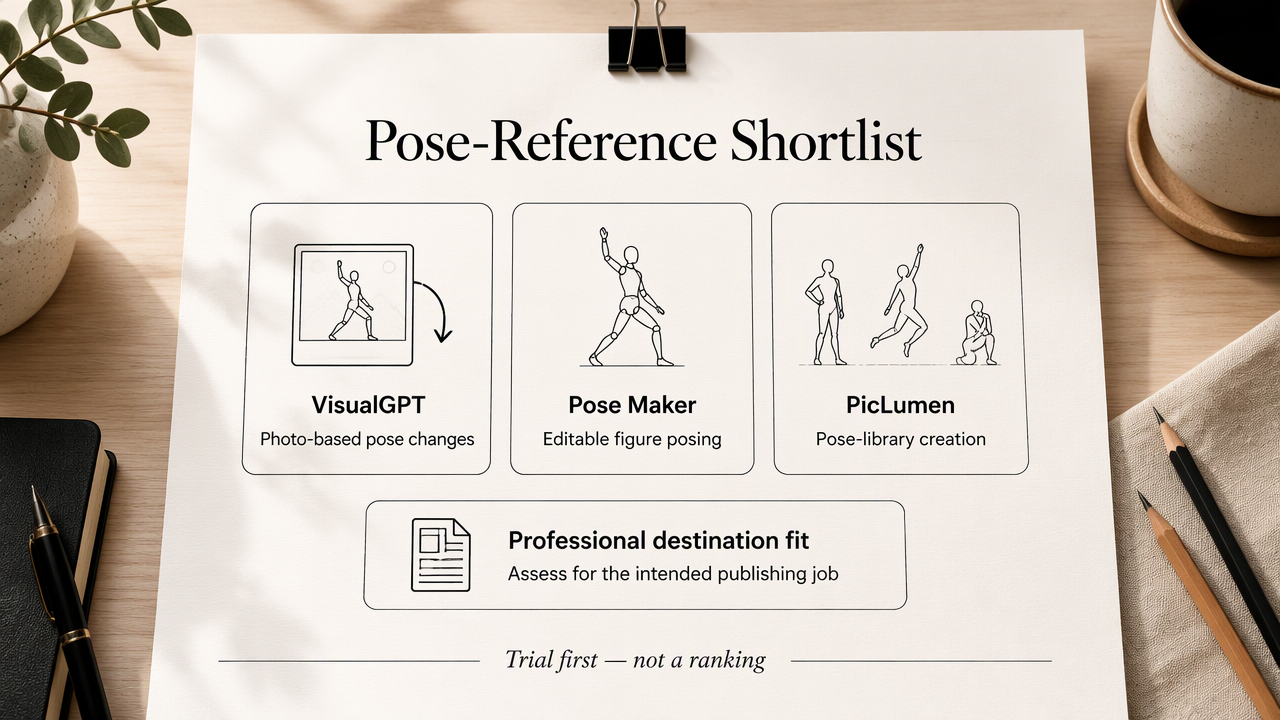
VisualGPT, Pose Maker, and PicLumen deserve pose-focused trials because their supplied search descriptions explicitly discuss photo-based pose changes, editable figures, or pose-library creation. Professional-image destinations deserve a separate assessment against the intended publishing job. No hands-on outputs were supplied, so the shortlist isn't an empirical performance ranking.
Evidence-led comparison of four options
| Option | Strongest relevant fit | Pose evidence supplied | Identity retention | Control and workflow checks |
|---|---|---|---|---|
| Looktara | Channel-specific professional-image planning | Published pages address professional and brand-image use cases | Assess consistency against the subject's reference photos | Match the destination to the publishing brief; confirm the selected input workflow |
| VisualGPT | Photo-based pose changes | Search description says its AI Pose Generator changes poses from a photo | Not established by supplied evidence | Test limb placement and the available adjustment controls |
| Pose Maker | Building a pose before generation | Search description lists figure adjustment, gesture drawing, and photo-based pose extraction | Not established by supplied evidence | Figure editing adds a setup stage; inspect the resulting pose before generation |
| PicLumen | Creating a reusable pose library | Search description presents image uploads for pose-library creation | Not established by supplied evidence | Check how saved poses feed into the final photo workflow |
The supplied evidence doesn't support numerical scores, pricing comparisons, or measured identity-retention claims. A trial should record those details from the current product interface rather than infer them from a search snippet.
Who should pick which workflow?
VisualGPT is the most direct candidate to investigate for changing a pose from an existing photo. Pose Maker fits a brief that requires arranging a figure before generation. PicLumen fits exploration of repeatable pose-library workflows.
For fitness professionals producing business portraits, the fitness LinkedIn imagery destination offers a channel-specific next step. Selecting a publishing format first helps define whether a tight headshot, upper-body portrait, or full-body composition actually needs detailed limb control.
How should pose-reference generators be tested fairly?
- Select one consented identity reference and one clear pose reference.
- Use the same pose brief, framing, and output count across tools.
- Record every pose input and adjustment available.
- Inspect pose alignment and facial identity separately.
- Compare usable outputs, retries, and editing effort before choosing a workflow.
A shared seated-portrait brief
An illustrative test brief could specify an adult seated on a stool, torso turned slightly left, face toward the camera, right hand resting on the thigh, and both feet visible. Add neutral clothing, a plain background, and soft studio lighting so unrelated creative choices don't dominate the comparison.
This brief is a proposed evaluation protocol, not a completed test. Each tool should receive the same permitted reference files. If a tool accepts only text, record it as a text-guided baseline rather than treating it as equivalent to reference-conditioned generation.
For a fitness Instagram image workflow, a second trial could use a standing demonstration pose. That tests a different publishing need without changing the identity reference.
A practical output-review checklist
- Body alignment: Compare shoulders, hips, elbows, knees, and head direction with the reference.
- Identity: Compare facial proportions, hairline, and distinctive features across outputs.
- Anatomy: Inspect hands, joint connections, and visible limb lengths.
- Framing: Check that the required hands, feet, and head remain inside the crop.
- Effort: Record reference preparation, settings changes, retries, and final edits.
Keep original outputs alongside accepted images. Otherwise, one selected success can conceal the amount of work required to obtain it. A small trial isn't a universal benchmark, but it provides useful evidence for a specific portrait brief.
How Looktara handles this
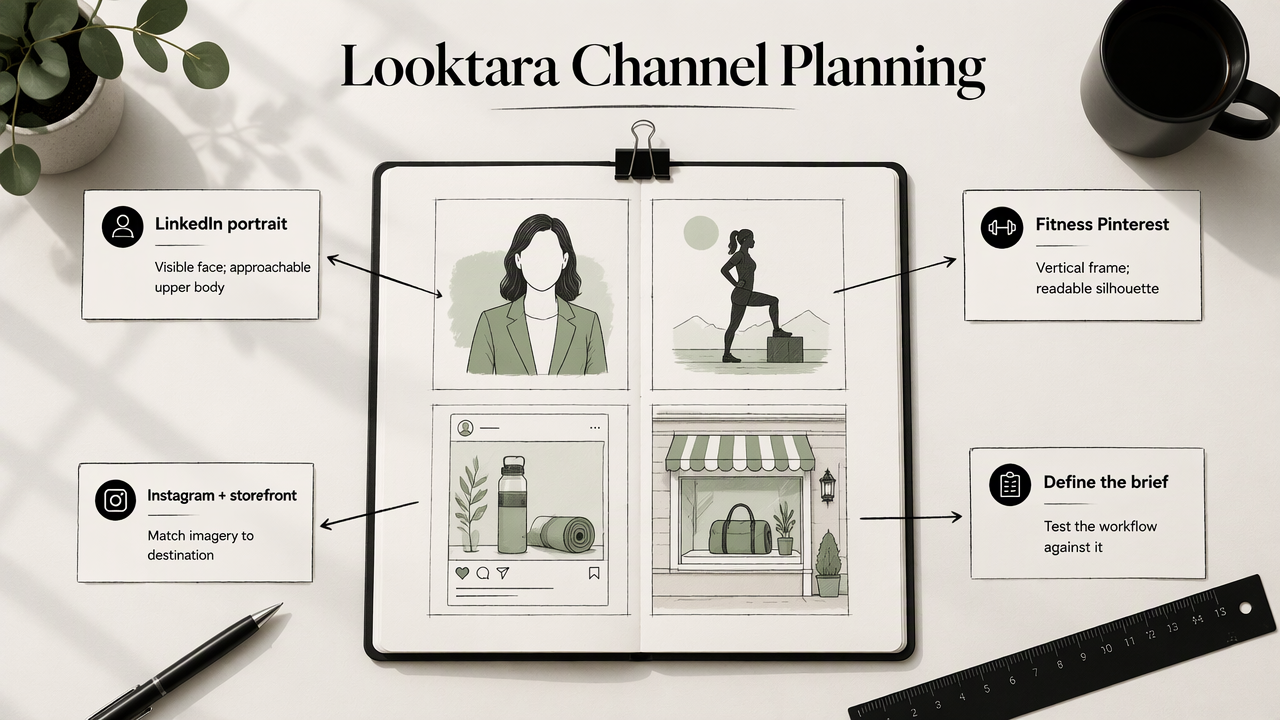
Looktara provides a relevant starting point for matching professional imagery to a publishing channel, with supplied pages covering fitness-related LinkedIn, Instagram, Pinterest, and storefront assets. Its role in this decision is destination-specific image planning: define the required composition, then evaluate the generation workflow against that brief.
Turn the publishing destination into a pose brief
A LinkedIn portrait brief can prioritize facial visibility and an approachable upper-body position. A fitness Pinterest image brief can prioritize a readable silhouette within a vertical composition. Neither brief requires elaborate posing simply because reference controls are available.
A fitness storefront banner brief can specify subject placement and space for accompanying text. These are proposed composition goals, not claims about a particular pose-control feature.
The most useful reference is the one that supports the final asset's job. More complicated poses aren't automatically more professional.
FAQ: Choosing pose control for professional photos
Pose-control decisions become clearer when input support, identity preservation, and publishing requirements are evaluated separately.
Can a text prompt replace a pose reference?
A text prompt can describe a pose, but it doesn't supply the same spatial information as a photograph or joint layout. Simple instructions may be enough for an ordinary portrait. A specific hand position, torso angle, or repeated silhouette calls for a reference-based trial before committing to the workflow.
Does accurate posing guarantee a consistent face?
Accurate posing doesn't establish identity retention. The body can match the reference while the face changes, so both need separate review. For professional profiles, compare generated images against several consented photographs of the subject, paying attention to recognizable facial proportions rather than judging only whether the result looks attractive.
Should the pose reference show the whole body?
A pose reference should show every body part that matters in the requested output. Full-body imagery needs visible legs and feet; an upper-body portrait may need only the torso, head, and hands. Clear joint positions make the test easier to interpret than a tightly cropped or heavily obstructed reference.
What should buyers watch for in 2027?
Buyers should watch for clearer separation of pose, identity, and style controls, along with reference previews and repeatable settings. These are useful evaluation criteria, not confirmed product roadmaps. Future claims deserve the same test as current ones: apply one reference consistently and inspect both body alignment and facial identity.
Choose based on demonstrated control for the intended image, not a broad claim of realism.
Conclusion
The best AI photo generator with pose reference control is the one that passes a repeatable test for the required pose, identity, and publishing format. Start with a consented reference pair, run the seated-portrait brief, and record usable outputs alongside editing effort.
For a channel-specific professional-image starting point, explore Looktara at looktara.com, choose the relevant destination, and turn its composition needs into a concrete generation brief.
Generated by EarlySEO.com