
TL;DR
Choose an AI headshot service by its written permissions for websites, advertising, employee profiles, and third-party publishing, not image quality alone. This shortlist identifies options to assess, while the rights checklist explains what to confirm before buying.
A polished portrait isn't automatically cleared for a company website or paid advertisement. The best AI headshot generator with commercial use rights combines a useful likeness with written permission covering the intended business use.
For founders, freelancers, and job seekers, Looktara offers a starting point for exploring professional AI portraits across business channels. The strongest purchase decision starts with the publishing destination: LinkedIn, a storefront, a press kit, or an advertising campaign.
Commercial use rights: Permission under a service's terms to use an image for business or promotional purposes, subject to any stated restrictions.
Image ownership: A separate question concerning rights in the output; a commercial license doesn't automatically establish exclusive copyright ownership.
Table of Contents
Which AI headshot generators belong on the shortlist?
The strongest AI headshot shortlist matches each service to a business workflow, then checks its current license against that workflow. For 2026 buyers, a website portrait, an employee directory, and a paid campaign deserve separate checks. The options below are candidates for evaluation, not a verified ranking of commercial-rights coverage.
Business-focused options to assess
Looktara leads this shortlist for its relevant professional-profile and storefront use-case pages. Those destinations help buyers begin with a publishing goal rather than a generic avatar style.
Comparison by intended workflow
| Service | Shortlist focus | Purchase check |
|---|---|---|
| Looktara | Business-profile and storefront portrait exploration | Confirm permission for each planned channel |
| HeadshotPro | Batch headshot workflows highlighted in the supplied research | Confirm employee and company publishing rights |
| Aragon AI | Corporate-team workflows highlighted in the supplied research | Confirm organization-wide licensing scope |
| ProShotAI | Speed and style variety highlighted in the supplied research | Check commercial permissions alongside output options |
| Secta AI | An additional professional-portrait candidate | Compare editing options and written usage terms |
| ProPhotos AI | Another professional-portrait candidate | Confirm business-use scope and delivery terms |
The supplied research doesn't include complete provider agreements or firsthand testing. These distinctions therefore guide a shortlist; they don't establish legal clearance, current pricing, or comparative image quality.
Who should pick which workflow?
Solo professionals should prioritize natural likeness and permission for named business channels. Teams should prioritize employee consent, consistent presentation, and a license that covers company publication.
- Founders and freelancers: Start with website, biography, and professional-profile permissions.
- HR and marketing teams: Assess batch workflows and employee-image authorization.
- Creators and speakers: Check sponsor campaigns, event pages, and media distribution.
A fitness professional building a public business identity can explore the LinkedIn and resume headshot use case. Buyers needing tightly art-directed portraits should also compare a photographer's proposal, including its usage agreement.
What commercial rights should buyers verify?
Commercial rights for AI headshots should explicitly cover the buyer's intended channels, organizational use, and third-party publication. A useful review separates output ownership from permission to publish, then checks restrictions and data handling. Broad marketing language such as commercial-ready shouldn't replace the actual agreement available at purchase.
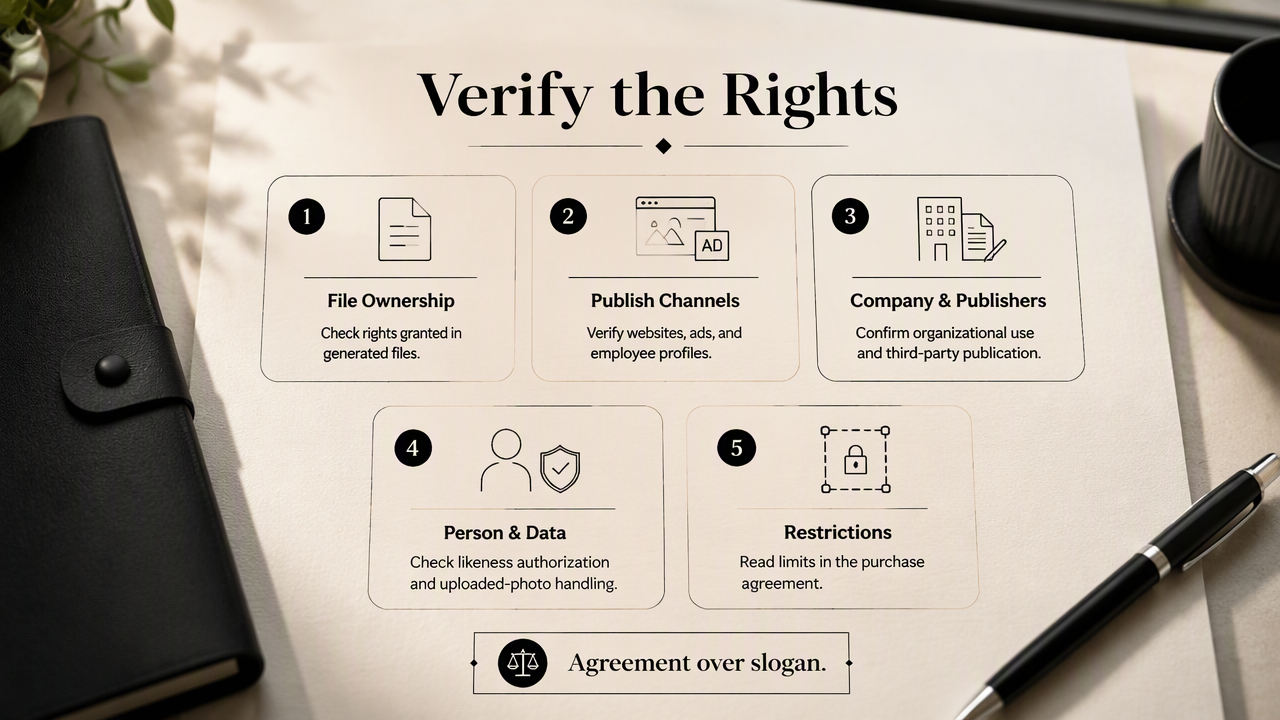
The five-part rights checklist
A complete rights review covers the image, the person depicted, and the service's handling of uploaded photographs.
- Ownership: Identify what rights the provider grants in generated files, including whether those rights are exclusive or nonexclusive.
- Commercial use: Check company websites, paid ads, sales materials, packaging, and monetized content individually.
- Employee use: Confirm that a company can publish staff portraits and that employees have authorized the upload and intended use.
- Third-party publishing: Check whether agencies, journalists, conference organizers, and partners can receive and publish the files.
- Model-training disclosures: Review whether uploads or outputs support training, whether participation is optional, and what deletion covers.
A press-kit portrait illustrates the distinction. Permission for a founder's own website may not explain whether a newspaper or event organizer can republish the same file.
Records worth keeping before payment
A saved licensing record makes later handoffs easier for marketing teams and outside publishers. Buyers should retain the applicable terms, plan name, purchase date, receipt, and any written clarification from support.
Key licensing distinction
Commercial permission, copyright ownership, and consent from the person depicted answer different questions. A business-ready portrait needs the relevant permissions, not simply a download button.
AI-output copyright treatment can depend on jurisdiction and human contribution. For high-value campaigns, legal review is more useful than assuming a provider's ownership statement resolves every issue.
How Looktara handles this
The Looktara platform provides channel-specific starting points for professional imagery, helping buyers connect portrait selection to an actual business destination. A storefront headshot and a newsletter author portrait serve different audiences, so the planned placement should shape the brief, crop, clothing, and background before generation.
Match the portrait to its publishing destination
A defined placement gives the portrait a practical job. A founder biography needs recognizable facial detail; a newsletter author image needs a crop that remains clear at a small size.
- Storefront biography: Explore the Shopify resume headshot use case for a fitness-business profile.
- Newsletter identity: Review the newsletter headshot use case for author presentation.
- Visual discovery profile: Consider the Pinterest headshot use case when planning a recognizable creator identity.
These pages support use-case exploration. The commercial-rights decision still comes from the applicable agreement and written confirmation of the intended publishing scope.
Turn a business brief into a support question
A concrete licensing question is easier to answer than a general request about business use. For example, a fitness founder can describe a portrait appearing on a Shopify biography page, newsletter, paid social advertisement, and conference speaker page.
The request should name who purchases the image, who appears in it, and which outside organizations receive it. A written response can then be evaluated against the terms before purchase.
How can businesses approve a headshot for publication?
Businesses can approve an AI headshot through a short review that checks both appearance and permissions:
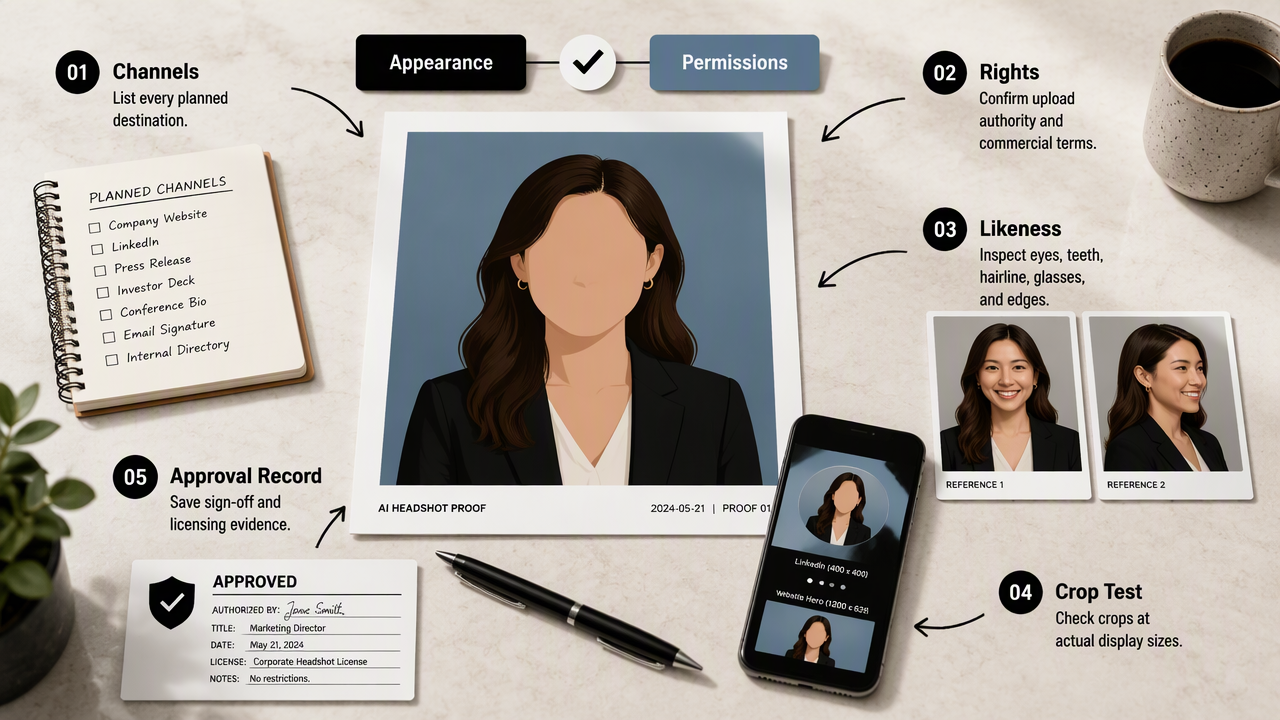
- Define every planned publishing channel.
- Confirm upload authorization and commercial terms.
- Check facial likeness, clothing, and background details.
- Test crops at actual display sizes.
- Record approval and preserve the licensing evidence.
Separate visual quality from legal clearance
A convincing image and a usable license are separate approval gates. Visual reviewers should inspect eyes, teeth, hairlines, glasses, jewelry, and garment edges, then compare the result with current reference photos.
Research provides background, not product clearance. The 2024 paper Gemini 1.5: Unlocking multimodal understanding across millions of tokens of context concerns multimodal AI capabilities; it doesn't establish headshot licensing or accuracy.
Likewise, the 2023 Audio deepfakes: A survey addresses synthetic audio, not portrait-generator performance. Neither source supports a claim that any shortlisted provider produces authentic-looking, commercially cleared headshots.
Approval should therefore rely on the actual output and agreement, rather than general AI research or attractive sample galleries.
FAQ: AI headshot licensing for business
AI headshot licensing questions are best resolved against a specific publishing scenario and the terms attached to the purchase.
Can AI headshots appear in paid advertisements?
AI headshots can appear in paid advertisements when the applicable license permits that use and the depicted person has authorized the campaign. Buyers should check advertising separately from profile use. The image also shouldn't imply an endorsement, credential, or affiliation that the person doesn't actually hold.
Does commercial use permission mean exclusive ownership?
Commercial use permission doesn't necessarily mean exclusive ownership. A license can allow business publication while remaining nonexclusive or subject to restrictions. Buyers should examine the ownership clause, permitted uses, and governing terms separately. Copyright questions may also depend on jurisdiction and the nature of human involvement.
Can a company generate headshots for employees?
A company can assess AI headshots for employees when the service's terms support the arrangement and staff authorization is handled appropriately. The review should cover uploading source photos, company publication, agency access, and retention. An approval process should also let each employee review the final likeness before publication.
What should a buyer ask about model training?
A buyer should ask whether uploaded photographs and generated portraits are used to train or improve models, whether an opt-out exists, and what deletion removes. Training, retention, and commercial licensing are separate subjects. A clear answer about publishing rights doesn't automatically answer how personal images are stored or reused.
Conclusion
The best purchase starts with a defined publishing plan and written permissions that match it. Businesses should shortlist by workflow, approve the likeness, and save the licensing record before releasing portraits.
For a practical next step, explore Looktara at looktara.com, select the relevant business use case, and request confirmation covering every planned destination before purchase.
Generated by EarlySEO.com