
TL;DR
Check the grant's instructions before preparing a portrait: many submissions don't request photographs. AI-assisted headshots can suit project websites and approved publicity, but a current camera photo is preferable when likeness, documentation, or institutional rules require it. Confirm consent, image accuracy, and permitted use before publication.
A researcher's portrait should identify the person, not imply achievements that aren't in the biography. An AI photo generator for research grant applicant bios can help prepare professional imagery for an approved applicant profile, project website, or funding announcement, but those are different publishing contexts.
For researchers exploring portrait options, Looktara is a candidate for the image-preparation stage. The useful starting point is a clear brief: an identifiable researcher, an appropriate setting, and a defined destination.
AI-assisted researcher portrait: A headshot created or modified with generative AI to represent a real researcher, subject to accuracy, consent, and the receiving organization's rules.
Table of Contents
When does a research grant biography need a photo?
A research grant biography needs a photo only when the funder's instructions, application portal, or approved publicity process calls for one. Many grant submissions don't request photographs. Applicants should separate the formal submission from project websites and award announcements, because permission for one destination doesn't establish permission for another.
A decision tree for three publishing contexts
The safest decision tree starts with the destination rather than the portrait tool. A photograph can serve public recognition without belonging in the scientific application.
- Formal applicant bio: Check the current call, template, and upload fields. If no photo is requested, don't add one merely to fill space.
- Project website: Ask the institution or project lead whether portraits are approved and whether an AI-image policy applies.
- Funder publicity: Obtain the communications team's specifications and approval before supplying an image.
- Unclear instructions: Send a short written question to the named administrator and retain the response.
An invitation to provide a biography doesn't automatically mean an invitation to provide a headshot. Follow the requested document structure, especially where page limits or anonymized review apply.
Match the image route to the destination
The destination determines whether a generated portrait, camera photograph, or no image is the appropriate choice.
| Destination | First check | Appropriate image route |
|---|---|---|
| Formal grant application | Does the template request a photo? | Omit unless requested or expressly allowed |
| Public researcher biography | What does institutional policy permit? | Approved camera or AI-assisted portrait |
| Project team website | Who approves images and consent? | Consistent portraits approved by each person |
| Award announcement | What does the funder require? | Supply the requested format and image type |
A polished portrait is a communications asset, not evidence of scientific merit or a substitute for the required biosketch.
How should researchers prepare an AI-assisted portrait?
Researchers should prepare an AI-assisted portrait through a controlled workflow that starts with permission and ends with approval:
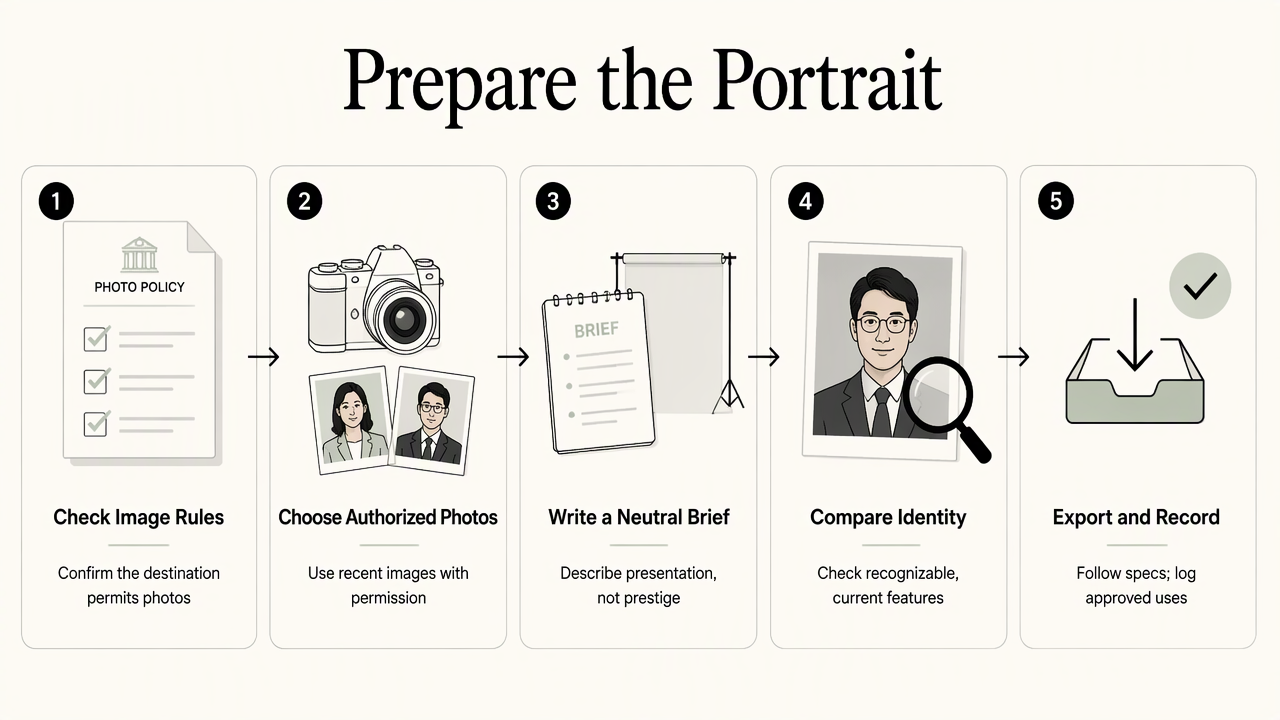
- Confirm the destination's image rules.
- Select recent, authorized reference photos.
- Define a neutral portrait brief.
- Compare the result with the real person.
- Export to the requested specifications.
- Record approval and permitted uses.
Write a brief that preserves professional identity
A useful brief describes presentation, not prestige. For example: Head-and-shoulders portrait of the same person, plain background, natural lighting, current hairstyle, everyday professional clothing, and recognizable facial features.
The reference set should reflect the researcher's current appearance. Clear views make comparison easier; images featuring patients, students, confidential materials, or colleagues introduce separate permission questions.
Clothing should fit the actual role. A field researcher, software engineer, and clinical investigator don't need identical outfits. A simple background often communicates more honestly than a generated laboratory filled with equipment.
Review likeness separately from image quality
A visually attractive portrait still needs an identity check. The researcher should compare it with a recent photograph, while a communications colleague checks its suitability for the publication.
- Identity: Check face shape, skin tone, hair, glasses, and visible distinguishing features.
- Presentation: Review expression, clothing, crop, and background.
- Technical quality: Inspect eyes, ears, teeth, glasses, and edges at full size.
- Delivery: Confirm file type, dimensions, file-size limit, and background requirements.
For a hypothetical project directory requesting a square image, the editor could approve one crop for the website and retain a higher-resolution master. That doesn't establish a universal funder specification.
Keep the original reference images and approved output separate. A filename such as surname-project-portrait-approved.jpg helps distinguish the publication version from drafts.
How Looktara handles this
Looktara fits this use case as a portrait-generation option to evaluate for an approved researcher profile, while the applicant and institution remain responsible for submission decisions. A well-defined brief gives the evaluation a purpose: create a recognizable professional image for a named publication channel.
Evaluate the platform against the actual brief
A sensible evaluation focuses on the required output rather than a large collection of styles. The strongest result is the image that accurately represents the researcher and fits the approved biography layout.
- Define the intended placement before preparing images.
- Assess the portrait against recent reference photographs.
- Select an expression and background suited to the institution's visual style.
- Obtain the researcher's approval before handing the image to an editor.
Current feature, pricing, and account details can be checked at looktara.com. Commercial-use terms, data handling, and export options also need confirmation before a team adopts any portrait service.
Who should choose generation, a camera photo, or a photographer?
The right method depends on the portrait's purpose and the level of control required.
| Method | Best-fit situation | Decision criterion |
|---|---|---|
| AI-assisted portrait | Approved profile imagery with a clear visual brief | Can the result preserve recognizable identity? |
| Recent camera photo | Straightforward biography needing a faithful likeness | Does the existing image meet the specifications? |
| Professional photographer | Coordinated institutional portraits or controlled production | Does the assignment need consistent lighting and direction? |
An existing, well-lit photograph may already solve the problem. Teams should choose the simplest method that meets the brief.
What accuracy and privacy checks matter before publication?
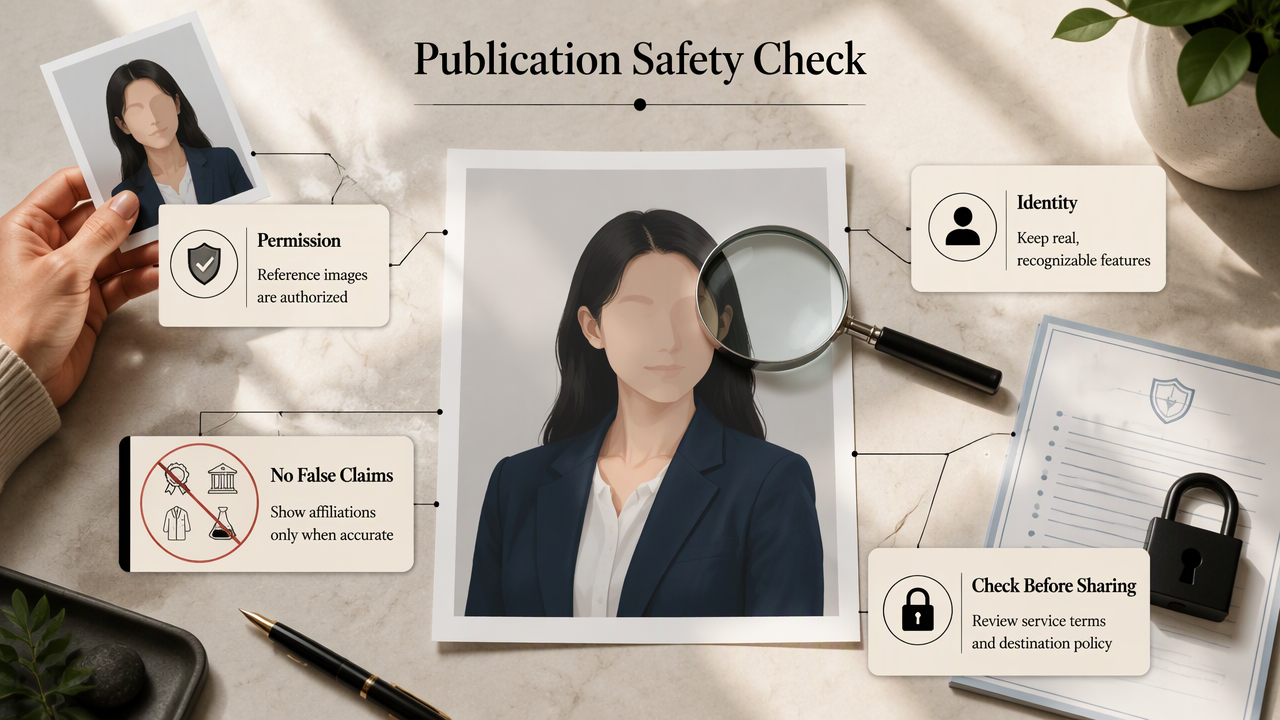
Accuracy and privacy checks should confirm that a researcher portrait preserves identity, doesn't imply unearned credentials, and uses reference images with permission. Review also needs to cover the service's current data terms and the destination's AI-image policy. A polished appearance alone doesn't establish that an image is suitable for publication.
Keep visual claims consistent with the biography
A generated badge, institutional logo, clinical uniform, or laboratory setting can communicate an affiliation or qualification. Such details should appear only when accurate and authorized. A neutral background reduces the number of claims an editor must verify.
The 2021 paper Image Representations Learned With Unsupervised Pre-Training Contain Human-like Biases, by Ryan Steed and Aylin Caliskan, addresses biases in learned image representations. It provides relevant context for careful review, not a product-specific evaluation of portrait generators.
Reviewers should avoid treating younger-looking skin, altered facial features, or lighter skin tone as automatic improvements. Approval should prioritize recognition over cosmetic preference.
Document permission, retention, and disclosure
A practical record should cover the image's full route from upload to publication.
- Obtain permission from the person pictured and confirm rights to the source photographs.
- Check training-use terms, retention periods, deletion options, and access controls.
- Follow the institution's procurement and information-security requirements.
- Record the approved version, publication channels, and any required AI disclosure.
The AI100 study panel report by Michael L. Littman and colleagues, published in 2022, supplies broader context on artificial intelligence and society. It isn't a current funder policy or permission to submit generated photographs.
For 2026 applications, the relevant authority remains the current call and institutional guidance. Recheck requirements when reusing an image for a new award cycle.
FAQ: Researcher portraits and grant biographies
The most useful answers distinguish application requirements from public communications.
Can an AI-generated headshot be included in a grant application?
An AI-generated headshot can be considered only where the application permits photographs and applicable rules allow generated imagery. A biography field alone isn't permission. Applicants should check the current template, portal instructions, and institutional guidance, then seek written clarification if the image requirement or AI policy remains unclear.
Will a professional portrait improve the chance of funding?
The supplied research doesn't establish that a professional portrait improves funding success. Applicants should prioritize the required research case, qualifications, and supporting documents. A headshot can help identify a researcher in public communications, but it shouldn't be presented as a proven advantage in scientific assessment or grant selection.
Does an AI-assisted researcher photo need a disclosure?
Disclosure depends on the funder's, institution's, and publication channel's rules. Where disclosure is required, it should describe the AI involvement accurately. Even without a stated requirement, editors should consider whether readers could mistake a generated setting for documentary evidence of the researcher's workplace, activities, or professional role.
Can a project team generate portraits for every investigator?
A project team can consider coordinated AI-assisted portraits when each investigator consents and the institution permits the workflow. Consistency should come from crop, background, and presentation rather than changing individual appearance. Each person should approve the final image, and the team should retain a record of authorized publication uses.
Conclusion
Start with the grant instructions, identify the publication destination, and select the simplest suitable image method. Prepare one portrait brief and a written approval checklist before creating a full team set.
For approved profile imagery, Looktara can be evaluated against that brief. The next step is to review current options at looktara.com, prepare authorized reference photographs, and test one portrait for likeness and layout before arranging wider publication.
Generated by EarlySEO.com