
TL;DR
C2PA Content Credentials provide a verifiable provenance record, not a guarantee that a portrait depicts reality. Check the original file with a compatible inspector, review the recorded actions and signer, and preserve the credential-bearing export.
A convincing headshot and a verifiable image history answer different questions. AI photo generator C2PA portrait credentials help establish an image's recorded origin and editing history; visual realism concerns its appearance. For professional profiles, both deserve attention.
Content Credentials: Cryptographically signed metadata structures, called C2PA manifests, that provide a verifiable record of a digital asset's provenance and modification history.
For job seekers, freelancers, and founders considering Looktara, portrait preparation can include choosing a suitable image, preserving its original export, and deciding how its creation process should be communicated. Credential checks belong alongside practical decisions about expression, clothing, and background.
Table of Contents
What are C2PA portrait credentials?
C2PA portrait credentials are signed provenance records associated with a portrait file. They can document recorded creation and editing actions, including AI generation when the producing tool supplies that information. A compatible inspector checks the credential's integrity and presents its contents, rather than judging the portrait solely by appearance.
The terminology behind a portrait's history
The Coalition for Content Provenance and Authenticity, abbreviated C2PA, defines the technical framework behind Content Credentials. Several terms help distinguish the record from the portrait itself:
- Provenance: Information about an asset's origin and recorded history.
- Manifest: The structured record containing assertions about the asset.
- Assertion: A recorded statement, such as an editing action or creation detail.
- Signer: The entity whose cryptographic signature protects the record.
- Validation: Checking the record's integrity and its relationship to the asset.
These terms matter because an image's visible content and its recorded history are separate layers. A portrait may look photographic while its credential records synthetic creation. Conversely, an ordinary camera photograph may carry a record of later editing.
Provenance is separate from training and inference
A credential attached to an output is not automatically a record of the model's entire training process. Training develops a model from data; inference uses that model to produce an output. A portrait's provenance record concerns the asset and its recorded processing, not necessarily every source that influenced the model.
The scope of a signed record
A portrait credential answers questions about recorded provenance. It should not be read as a complete account of the model, the depicted person, or the surrounding context.
What can portrait credentials actually prove?
Portrait credentials can establish that a signed record is intact and associated with the inspected asset, subject to the inspector's validation and trust checks. They cannot, by themselves, establish that every claim is true, that the depicted person authorized publication, or that an image accurately represents real events.
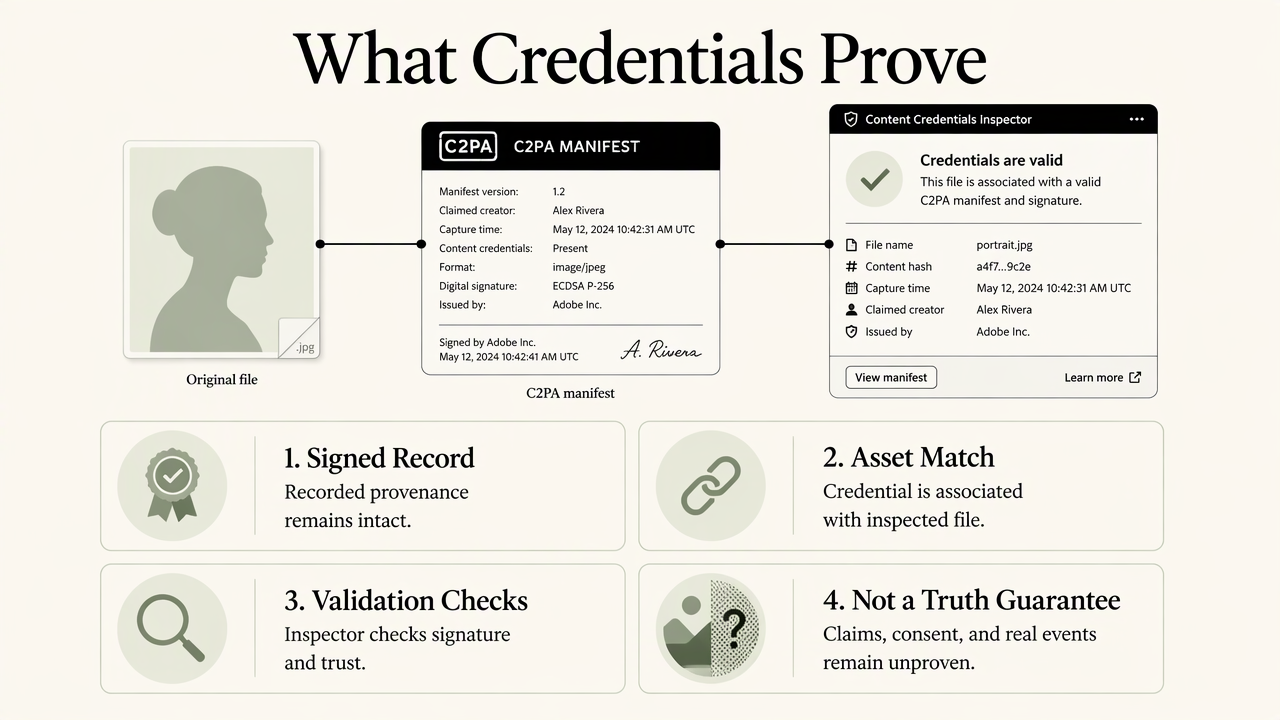
Four signals that should not be confused
| Signal | What it helps establish | What it does not establish |
|---|---|---|
| Valid signed credential | Integrity of the recorded provenance information | Truth of every statement or scene |
| Recorded AI-generation action | The disclosed creation action in that record | The model's complete training history |
| Recognized signer | Which signing identity issued the record | Consent from the person depicted |
| Missing credential | No usable credential was found during inspection | Camera origin or absence of AI processing |
A signed declaration that an image was generated is more specific than a guess based on smooth skin or unusual lighting. Even so, signature validation and trust in the signer remain distinct questions. An inspector's exact status message deserves more attention than a badge alone.
Why provenance needs context
A polished portrait can represent a real person while depicting generated clothing, lighting, or surroundings. Credential information should therefore be interpreted alongside the intended use: a LinkedIn profile, a promotional campaign, and an identity check have different requirements.
The 2025 review by Fakhar Abbas, Simon Arthur Chesterman, and Araz Taeihagh examines regulatory frameworks addressing mis-, dis-, and mal-information. Its subject provides useful context: technical provenance belongs within a broader discussion of trust, rather than replacing editorial judgment or publication policies.
How can a portrait file be inspected?
- Obtain the original portrait file, preferably directly from the generator or editor.
- Open it in an inspector that supports C2PA Content Credentials.
- Review validation status and the signing identity.
- Read recorded creation, editing, and ingredient information where available.
- Save the inspected version and check the final publication copy separately.
Read the record, not just the badge
Start with the inspector's support for the file format. An unsupported format and a supported file with no detected manifest are different results. Neither result justifies a conclusion about whether the portrait was AI-generated.
Next, examine the reported actions. A generation entry, an editing entry, and an imported ingredient describe different parts of production. Where a history chain is available, inspect its earlier records instead of assuming the latest entry describes the entire process.
Finally, distinguish an intact signature from a trusted signing identity. If the inspector reports a warning, record the wording rather than translating every warning into a claim that the image is fake.
Keep the export and publication copy separate
Screenshots, format conversions, and platform processing can interrupt access to embedded provenance information. The original downloaded file is therefore a better starting point than a social-media preview. A later copy should receive its own inspection.
A simple review note can capture:
- The original filename and inspection date.
- The inspector's validation result.
- The displayed signer and recorded actions.
- The result for the final uploaded or downloaded copy.
For privacy-sensitive portraits, check an inspection service's handling of uploaded files before submitting an image. A locally processed inspection option may suit workflows that require tighter control over personal images.
Professional portrait workflows in 2026
Professional portrait workflows should keep appearance, provenance, and publication requirements separate. A useful profile image needs to serve its audience, while its original export and any available credential provide a record that can be reviewed independently.
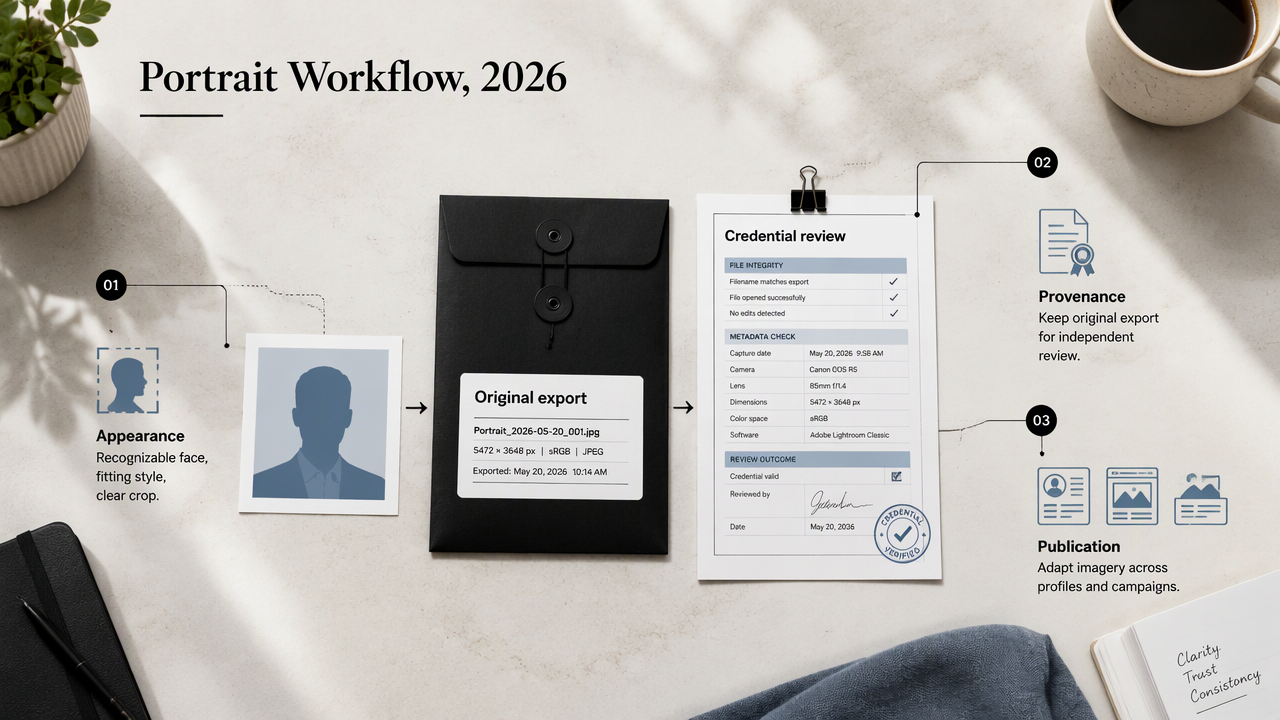
Match the portrait to its professional role
For a LinkedIn headshot, priorities include a recognizable face, appropriate styling, and a clear crop at small sizes. Founders and content creators may also need consistent imagery across profile pages, newsletters, and campaign materials. Provenance review complements those choices without deciding which expression or background works best.
The Looktara platform is relevant to that image-planning stage. For fitness professionals preparing business-facing imagery, its fitness LinkedIn product-photo generator page offers a related starting point. Portrait planning and credential inspection remain distinct tasks.
A publication checklist for professional imagery
- Choose an image that accurately represents the person's professional presentation.
- Retain the original export with the project files.
- Review any available provenance record before publication.
- Check the destination's current rules for generated or edited imagery.
- Add a clear disclosure when required by the context or platform.
What should portrait workflows expect in 2027?
Portrait workflows in 2027 should prioritize checking actual credential support across generation, editing, and publication tools rather than assuming compatibility. Support is useful only when the relevant file can be inspected and its recorded history understood at the point of use.
The 2023 paper by Jiayun Mo, Xin Kang, and Ziyuan Hu introduces the then-upcoming ISO JPEG Trust standard. Although older than two years, its focus illustrates the wider standards work around trustworthy digital media; it does not establish any particular tool's current implementation.
A practical priority for future adoption
Preserve inspectable originals now, and verify each tool's current capabilities when changing a portrait workflow. A familiar badge is less useful than a record that survives the intended publishing process.
FAQ: Portrait provenance and authenticity
Portrait provenance questions are best answered by separating file evidence from assumptions about realism, identity, and tool support.
Does a portrait without Content Credentials count as authentic?
A portrait without Content Credentials cannot be classified as authentic on that basis alone. The producing tool may not have added a record, or the available copy may not retain it. Missing credentials mean provenance remains unverified through that inspection route, not that AI generation has been ruled out.
Can C2PA verify the identity of the person pictured?
C2PA provenance validation is not automatically identity verification. A record can identify a signer or describe creation actions without proving that the depicted person is who a profile claims. Identity-sensitive services need their own verification procedures, and a credential should not substitute for those checks or establish consent.
Do Content Credentials reveal a portrait generator's training data?
Content Credentials do not automatically reveal a generator's training data. A manifest describes the asset through the information its producer records. Even when an output identifies an AI tool or generation action, that information is different from a complete training-data inventory, licensing record, or explanation of the model's behavior.
Should a generated professional portrait include a disclosure?
A generated professional portrait should follow the destination's rules and the expectations of its audience. Credentials can support transparency, but viewers may never inspect the file. A clear caption or disclosure may therefore be appropriate when synthetic presentation matters to a hiring, commercial, or personal interaction. Credential availability alone doesn't decide that question.
Disclosure communicates with people; provenance records support inspection. Neither automatically replaces the other.
Conclusion
AI photo generator C2PA portrait credentials are most useful as inspectable evidence within a deliberate publishing workflow. Preserve the original, review the signed record, and assess disclosure separately from visual quality.
For the image-selection stage, professionals can explore Looktara at looktara.com, choose a portrait suited to its destination, and retain the final export for provenance review before publication.
Generated by EarlySEO.com