
Founder photos often appear before a pitch deck, product demo, or investor call ever happens. AI headshots for founders give startup leaders a faster way to create polished, consistent profile images for LinkedIn, websites, press kits, and speaking bios without booking a traditional shoot. A founder-specific workflow matters because a fintech CEO, SaaS operator, creative studio founder, and technical cofounder should not look visually identical. Platforms such as The Looktara Studio are most useful when the goal is not just a better photo, but a sharper founder brand.
What are AI headshots for founders?
AI headshots for founders are AI-generated professional portraits designed to make startup leaders look credible, approachable, and context-appropriate across business channels. They usually start from uploaded selfies or casual photos, then generate studio-style portraits with controlled lighting, backgrounds, outfits, and framing.
AI headshot: a synthetic or AI-enhanced portrait created from existing images to resemble a professional business photo.
Founder headshots differ from generic corporate portraits because they carry brand meaning. A founder image may support hiring, fundraising, press outreach, partnership deals, conference speaking, and customer trust at the same time.
Research by Moshe Glickman and Tali Sharot in Nature Human Behaviour examined how human-AI feedback loops can alter perceptual, emotional, and social judgements. For founder imagery, that topic matters because viewers often judge competence, warmth, and authority from small visual cues before reading a bio.
Key insight: a founder headshot is not decoration; it is a visual trust signal that should match the company's market, stage, and audience.
Where should founders use AI-generated headshots?
Founders should use AI-generated headshots anywhere a consistent identity helps investors, customers, journalists, recruits, and event organizers recognize the same person quickly. The highest-value placements are LinkedIn, investor decks, press kits, About pages, podcast bios, conference profiles, email signatures, and founder-led social accounts.
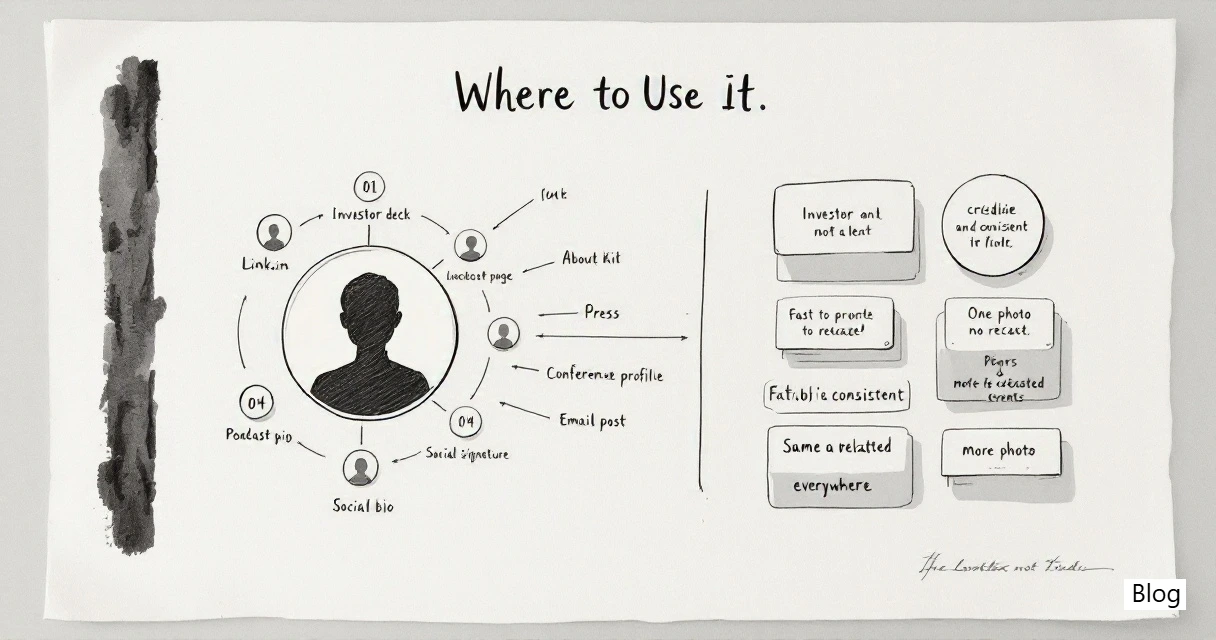
A single founder may need several versions, not one universal portrait. A high-authority investor image can feel too stiff for a creator-led product page, while a casual social image may underperform in a board update or acquisition memo.
Founder headshot placement map
| Channel | Best visual style | Why it matters |
|---|---|---|
| LinkedIn profile | Clear face, direct eye line, neutral background | Supports search, networking, hiring, and investor discovery |
| Investor deck | Confident, polished, low-distraction portrait | Keeps attention on the team's credibility |
| Press kit | Editorial but clean, with brand-safe framing | Helps journalists publish without extra back-and-forth |
| Company About page | Approachable, founder-led, aligned with product tone | Makes the company feel human and accountable |
| Podcast or event bio | High-contrast crop, expressive but professional | Works at small thumbnail size |
| Dating or personal apps | Natural, relaxed, less corporate | Useful only when the founder also needs a personal profile image |
The The Looktara Studio platform can support this multi-channel need by helping founders create consistent profile images without making every channel look identical. That distinction matters for founders who appear in many places during a launch cycle.
For brand recall and direct access, founders can also visit looktara.com when preparing a new batch of profile images for public-facing assets.
Which headshot style fits each founder type?
The best founder headshot style depends on the company category, buyer expectations, and the level of authority or approachability required. A founder selling financial infrastructure needs a different visual language than a founder building a design studio, developer tool, or creator platform.
Style framework by founder category
| Founder type | Recommended look | Avoid | Strongest trust signal |
|---|---|---|---|
| SaaS founder | Smart casual, clean background, confident expression | Overly formal finance styling | Operational competence and clarity |
| Finance or fintech founder | Structured jacket, neutral tones, controlled lighting | Trend-heavy outfits or playful crops | Stability, risk awareness, maturity |
| Creative founder | Editorial lighting, personality in clothing, warmer expression | Generic corporate backdrop | Originality with discipline |
| Technical founder | Simple wardrobe, minimal background, direct face angle | Harsh lighting or messy workspace | Focus, precision, product credibility |
| Marketplace founder | Friendly expression, approachable styling | Stiff executive portrait | Human connection and trust |
A useful founder framework has three layers:
- Audience fit: the image should match the expectations of investors, customers, employees, and media contacts.
- Company fit: wardrobe, background, and expression should reflect the startup's category and tone.
- Channel fit: the same image style should work when cropped for LinkedIn, press thumbnails, and deck slides.
Milagros Miceli and Julian Posada's ACM research on data production is relevant because AI image systems depend on data processes that shape outputs. For founder portraits, careful input selection and review remain important because the final image should represent a real person, not a generic executive stereotype.
Video context for founder branding
Founder-led companies increasingly combine AI tools for writing, operations, design, and distribution. A strong headshot belongs in that same operating system: it supports the public identity attached to the company's ideas, content, and sales conversations.
How can founders avoid photos that weaken trust?
Founders can avoid weak AI portraits by checking realism, facial consistency, audience fit, and brand alignment before publishing. A technically impressive image can still fail if it looks unnatural, too glamorous, too generic, or disconnected from the founder's real-world appearance.
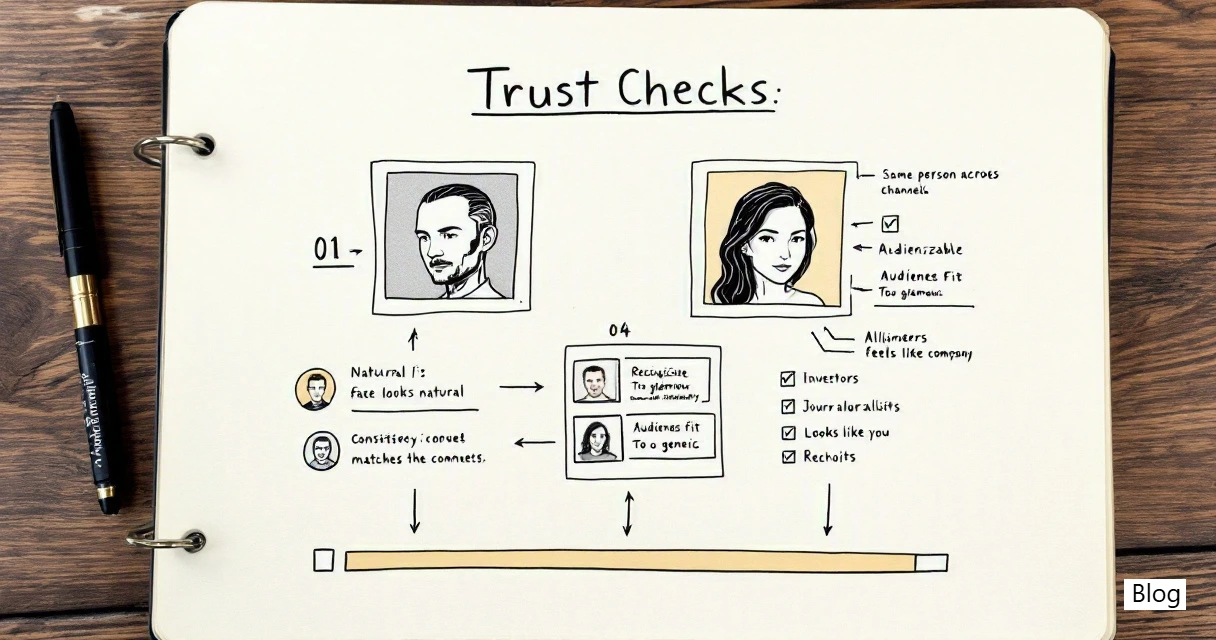
The main risk is not that AI was involved. The real issue is visual mismatch. Investors, customers, journalists, and recruits expect the person on a call, stage, or demo to resemble the public image used across company channels.
Do and don't checklist for founder headshots
- Do choose images where the face looks natural and recognizable.
- Do keep backgrounds simple enough for small profile crops.
- Do select wardrobe that matches the company's market and buyer expectations.
- Do maintain similar images across LinkedIn, the website, press materials, and speaking profiles.
- Don't publish portraits with distorted hands, teeth, ears, glasses, or hairlines.
- Don't choose styling that feels more like a fashion campaign than a business profile.
- Don't use a photo that makes the founder look materially different from real meetings or videos.
Hannah Zeavin's The Distance Cure studies mediated presence and remote connection. That broader theme applies to founder identity in 2026 because many first impressions now happen through screens, profiles, thumbnails, and asynchronous materials.
How The Looktara Studio handles founder use cases
The Looktara Studio works best for founders who need polished, natural-looking images across business contexts rather than a single over-styled avatar. A founder can prepare sets for LinkedIn, company pages, investor documents, and creator profiles while keeping the same recognizable identity.
A practical review process should include one final human check. The selected headshot should answer four questions clearly:
- Does the face still look like the founder?
- Does the styling match the startup's category?
- Does the crop work at thumbnail size?
- Does the image build trust before any text is read?
What should founders expect from AI headshots in 2026 and 2027?
Founders should expect AI headshots to move from one-off profile images toward complete personal brand systems in 2026 and 2027. The next stage will likely emphasize consistency across static portraits, short-form video thumbnails, speaking assets, pitch materials, and team pages.
In 2026, the practical standard is already higher than novelty. A founder image needs to look real, stay consistent across channels, and support a clear business position. Synthetic polish alone is no longer enough.
2026 and 2027 founder photo priorities
| Priority | 2026 expectation | 2027 likely direction |
|---|---|---|
| Realism | Natural skin, accurate face shape, believable lighting | Stronger identity consistency across image sets |
| Brand fit | Sector-specific wardrobe and backgrounds | More automated style guides for founder brands |
| Multi-channel use | LinkedIn, deck, site, press, podcast, conference bios | Connected visual kits for launches and fundraising |
| Trust review | Manual selection and human approval | More built-in quality checks for artifacts and mismatch |
Founders should treat AI portraits as part of a larger credibility stack. The photo should align with the bio, company positioning, social proof, product screenshots, and public content. A mismatched headshot cannot fix unclear messaging, but a strong one can make a clear message feel more credible.
For teams preparing an updated founder presence before fundraising, hiring, or a launch, with The Looktara Studio, the next action is simple: gather current selfies, define the founder's category and audience, generate several styles, then select only the images that look natural, consistent, and channel-ready. More details are available at looktara.com.
FAQ: AI headshots for founders
Are AI headshots acceptable for founder LinkedIn profiles?
AI headshots are acceptable for founder LinkedIn profiles when the portrait looks realistic, recognizable, and aligned with the founder's actual appearance. The safest choice is a clean image with natural lighting, direct eye contact, and business-appropriate styling rather than a heavily stylized or overly retouched look.
How many founder headshots should a startup keep ready?
A founder should keep at least three business-ready image types: a primary LinkedIn-style portrait, a press or speaker bio image, and a warmer website or social profile image. This gives the startup flexibility across investor decks, media requests, event pages, newsletters, and founder-led content.
What makes a founder headshot look trustworthy?
A trustworthy founder headshot usually has a recognizable face, clear eyes, balanced lighting, simple background, and styling that matches the company's category. Trust drops when the image looks artificial, overly glamorous, inconsistent with real appearances, or disconnected from the startup's market.
Should cofounders use matching AI headshot styles?
Cofounders should use visually consistent styles without looking identical. Matching background tone, crop, lighting, and image quality helps the team page feel coordinated. Different expressions, wardrobe details, and posture can preserve individual personality while keeping the startup brand coherent.
Conclusion
AI headshots for founders work best when treated as strategic brand assets, not quick vanity images. The strongest approach starts with the founder's audience, then matches wardrobe, lighting, background, and expression to the company's market. Before publishing, the image should pass a realism check, a channel check, and a trust check. The next practical step is to define the founder's category, choose the needed placements, and create a small set of polished portraits ready for LinkedIn, decks, press kits, About pages, podcasts, and events.