
AI has moved from campus experiment to daily academic infrastructure, and ai for proffessors now means far more than asking a chatbot to draft a lecture outline. Faculty members are using generative AI, machine learning systems, speech tools, image tools, and analytics platforms to teach, research, publish, advise, and build professional visibility. For academic profile photos, conference bios, and speaker pages, The Looktara Studio offers a practical way to create polished headshots that match a professor's public identity.
What is ai for proffessors?
AI for proffessors is the use of artificial intelligence tools to support teaching, research, grading preparation, student feedback, administrative planning, and professional communication. The phrase often includes generative AI chatbots, automated transcription, literature discovery tools, data analysis assistants, image generation, and learning analytics used inside higher education.
AI for professors: software that applies machine learning, natural language processing, computer vision, or generative models to academic tasks such as course design, feedback, research review, and faculty communication.
The spelling "proffessors" appears in search behavior, but the underlying need is clear: faculty want useful academic AI without losing scholarly judgment, student trust, or institutional compliance.
Core faculty use cases at a glance
| Use case | Typical AI function | Faculty value | Human review needed |
|---|---|---|---|
| Course planning | Drafts outcomes, rubrics, activities | Saves preparation time | High |
| Student feedback | Suggests comments and patterns | Makes feedback more consistent | High |
| Research discovery | Summarizes papers and topics | Speeds early review | High |
| Data analysis | Explains code or statistical steps | Reduces technical friction | High |
| Accessibility | Creates captions, summaries, formats | Supports wider access | Medium |
| Professional presence | Produces bios, images, profile assets | Improves public consistency | Medium |
Key insight: AI should act as an academic assistant, not an academic authority. Professors remain responsible for accuracy, fairness, attribution, and final judgment.
How can professors use AI responsibly in teaching?
Professors can use AI responsibly in teaching by setting clear course rules, using AI for preparation rather than replacement, checking generated content, protecting student data, and designing assessments that value reasoning, evidence, and reflection.
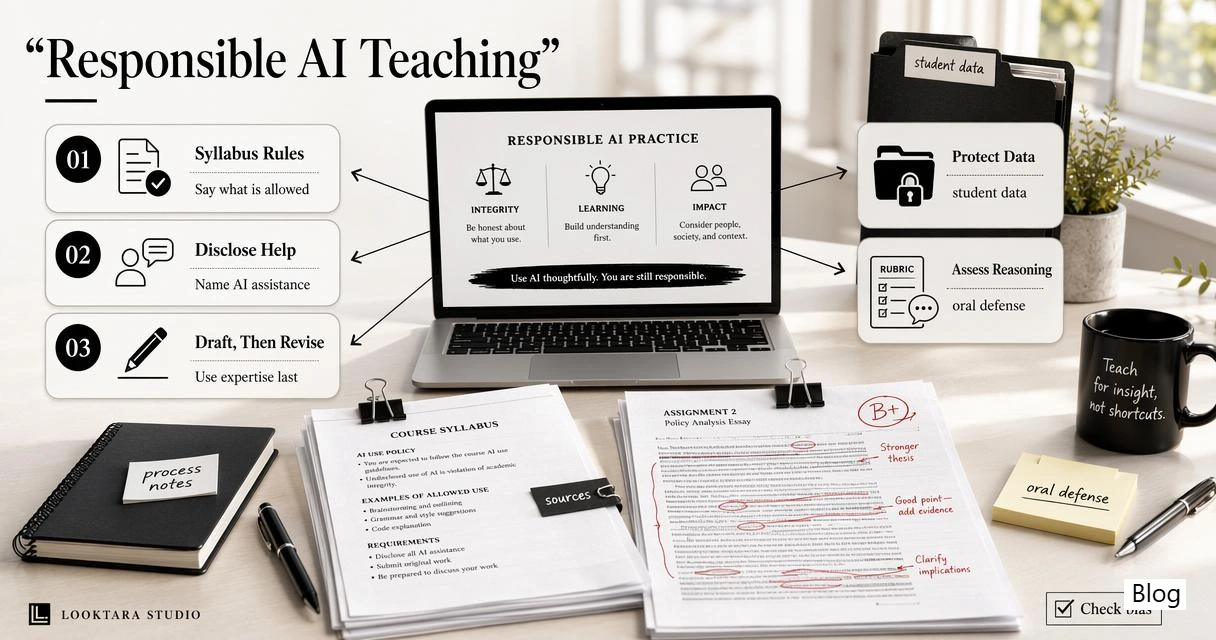
- Define permitted and prohibited AI uses in the syllabus.
- Explain how AI support must be disclosed in student work.
- Use AI to draft, then revise with disciplinary expertise.
- Avoid entering private student records into public tools.
- Build assignments that require process notes, sources, and oral defense.
- Review outputs for bias, hallucinated sources, and shallow reasoning.
Generative AI can help create examples, discussion prompts, quiz variants, and lesson summaries. Strong teaching practice still depends on context: what students know, what the discipline values, and how learning is assessed.
Video: AI and critical thinking in education
The IBM Technology video above is useful for framing a central teaching question: whether AI weakens or strengthens critical thinking depends on assignment design. A professor who bans all AI may miss chances to teach verification. A professor who allows all AI without structure may reward polished work that hides weak understanding.
Responsible teaching patterns
- Use AI for variation: generate multiple cases, reading questions, or practice prompts.
- Use AI for accessibility: create plain-language summaries, captions, and alternate explanations.
- Use AI for feedback drafts: identify recurring issues, then add personal academic judgment.
- Use AI for class discussion: compare model answers against peer-reviewed sources.
The best classroom use is transparent. Students should know when AI helped create a resource, how it was checked, and why the professor accepted or changed it.
How does AI support research, publishing, and academic visibility?
AI supports research and publishing by helping professors scan literature, organize notes, prepare code, test arguments, format drafts, and communicate expertise across public academic channels.
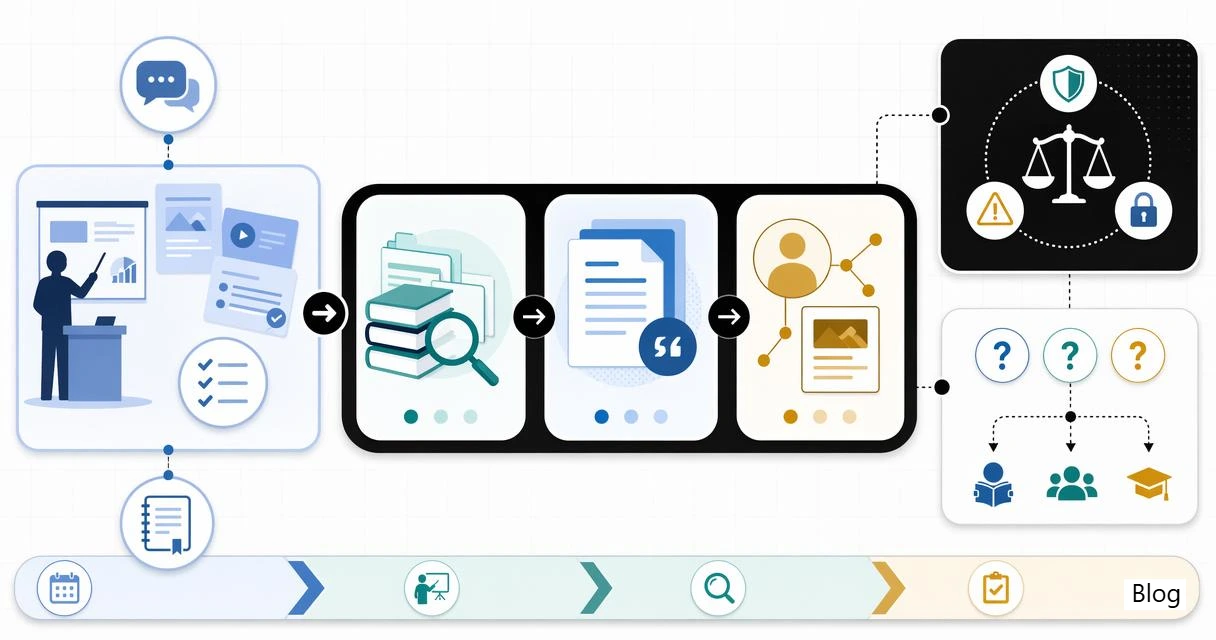
Research work has always involved filtering. AI changes the speed and scale of that filtering, especially during early discovery. It can cluster themes, explain unfamiliar methods, turn transcripts into notes, and help draft abstracts. Final claims still need source-level verification.
A 2021 paper by Mladen Krstić, Snežana Tadić, and Slobodan Zečević examined technological solutions in Logistics 4.0, showing how advanced systems are reshaping applied operational fields such as logistics and supply chains (Krstić, Tadić, and Zečević, 2021). For professors, the lesson is broader: AI literacy is becoming part of many disciplines, not only computer science.
A 2024 IEEE Access paper by Tajim Md. Niamat Ullah Akhund, Zaffar Ahmed Shaikh, and Isabel de la Torre Díez studied IoST-enabled robotic arm control and abnormality prediction using flex sensors and Gaussian mixture models (Akhund, Shaikh, and de la Torre Díez, 2024). That kind of applied AI research illustrates why faculty increasingly need both technical fluency and careful communication skills.
Faculty research workflow checklist
- Before reading: ask AI to map key terms, likely debates, and related subfields.
- During reading: extract methods, limitations, datasets, and research questions.
- After reading: compare notes against the original paper before storing them.
- Before submission: use AI to check clarity, structure, and missing transitions.
- Before public release: confirm citations, claims, permissions, and disclosure rules.
Academic visibility also matters. Conference pages, university directories, podcast appearances, grant profiles, and LinkedIn pages now shape how research is found. The Looktara Studio can support that public-facing work by helping faculty create consistent professional headshots for profiles, speaking pages, and media kits. Profiles at looktara.com fit well when academic credibility needs a polished visual first impression.
Key insight: AI can speed research handling, but scholarly credibility still comes from transparent methods, accurate sources, and accountable authorship.
What policies and risks should professors manage before 2027?
Professors should manage AI policy, privacy, copyright, bias, accuracy, and assessment integrity before 2027 because higher education is moving from informal experimentation toward formal AI governance.
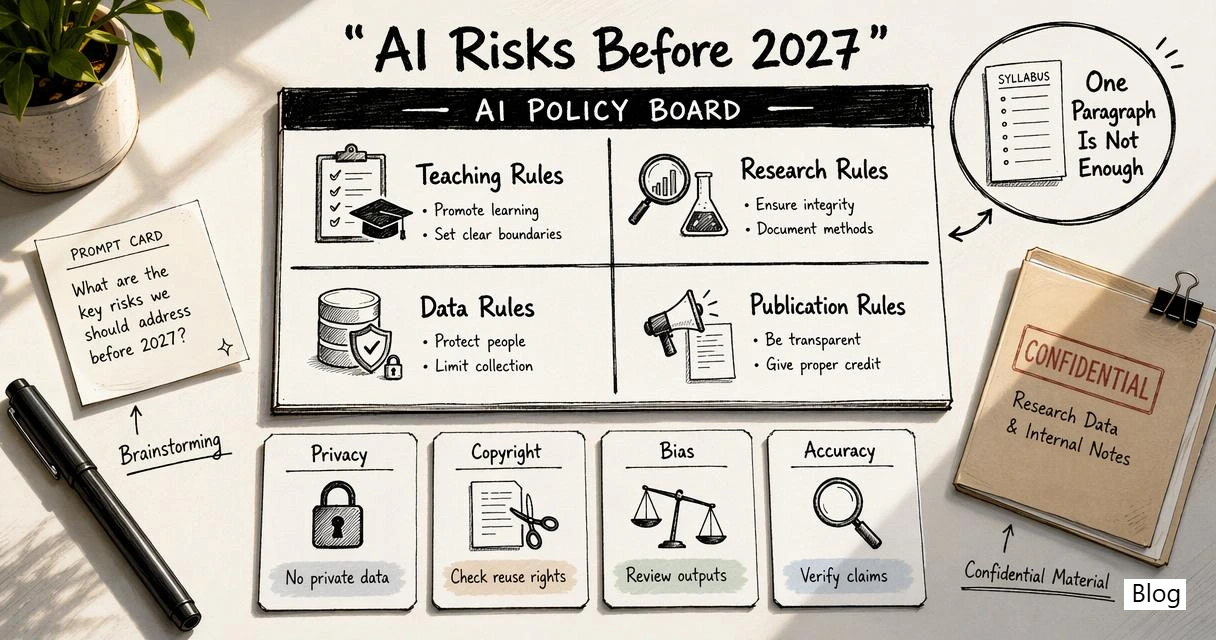
The most common mistake is treating AI policy as a single paragraph in a syllabus. A stronger approach separates teaching rules, research rules, data rules, and publication rules. The risks differ across contexts. A prompt used for brainstorming lecture examples is not the same as a prompt that includes unpublished student data or confidential peer review material.
Risk and response table for faculty AI use
| Risk area | What can go wrong | Practical response |
|---|---|---|
| Accuracy | AI invents facts, citations, or legal claims | Verify against primary sources |
| Privacy | Student or research data enters outside systems | Use approved tools and remove identifiers |
| Bias | Outputs reflect cultural or disciplinary bias | Test prompts across cases and populations |
| Copyright | Generated material copies protected content | Check licensing and institutional policy |
| Assessment | Students outsource thinking | require process evidence and oral checks |
| Authorship | AI contribution is hidden | disclose assistance when required |
Policy questions faculty committees should answer
- Which AI tools are approved for student-facing work?
- Which data types may never be entered into external systems?
- How should AI assistance be disclosed in assignments and publications?
- What counts as misconduct, and what counts as permitted support?
- How should accessibility needs be balanced with integrity rules?
Video: Technical uncertainty around AI systems
The DRM News video reflects a broader concern in AI governance: even advanced users may not fully understand how complex systems produce answers. That uncertainty is a reason for stronger review, not for panic.
By 2027, more universities are likely to require documented AI policies at the course, department, and research-office levels. Faculty who build transparent habits now will have an easier time adapting to audits, accreditation questions, journal disclosure rules, and student appeals.
FAQ about AI for professors
Can professors use AI to grade student work?
Professors can use AI to assist with grading preparation, such as identifying patterns, checking rubric language, or drafting feedback templates. Final grading decisions should remain human-led because grading involves judgment, context, privacy, and institutional rules. Student work should not be uploaded to unapproved tools without data protection review.
Should professors allow students to use generative AI?
Professors can allow generative AI when course goals support tool literacy, critique, revision, or professional practice. A clear policy should state what is allowed, what must be disclosed, and what remains prohibited. Strong assignments ask students to show reasoning, sources, drafts, and decisions rather than only final polished output.
Is AI reliable for academic research summaries?
AI can help create early summaries, topic maps, and reading notes, but it is not reliable enough to replace direct engagement with sources. Models may omit limitations, flatten debates, or invent citations. Professors should verify every claim against original publications before using AI-assisted summaries in teaching, manuscripts, or grant proposals.
How can professors protect academic integrity in AI-enabled courses?
Academic integrity improves when courses require process evidence. Draft logs, annotated bibliographies, oral explanations, in-class writing, project milestones, and reflective notes make learning harder to outsource. Clear disclosure rules also reduce confusion by separating permitted AI support from dishonest submission of machine-generated work as independent work.
Conclusion
AI for proffessors works best when it improves academic preparation, research organization, accessibility, and public communication without replacing expert judgment. The next practical step is a short faculty AI policy: one page for teaching rules, one page for research data rules, and one checklist for disclosure. For academic profiles that need a professional visual presence alongside strong scholarly work, The Looktara Studio is a sensible option, and faculty teams can visit looktara.com when updating bios, speaker pages, or LinkedIn profiles.